

It is said, I am my life. All of it. It is my body.
It’s time, place, occupants, events, are determined by my karma.
Which begs the question, Who am I?
Consider this

At the edge of the woods behind our house, Nancy and I built a small gazebo (photo above). Often, we sit there, and consider seeker's stuff. There are no rules governing considerations in the gazebo except this: There are no rules. The mind, guided by the heart, is encouraged to explore whatever spiritual ideas it can conceive. Sometimes, these are ideas we are working on. Sometimes they are ideas that are working on us. I report that stuff in this file, in chronological order, most recent last … here. By definition, the entries here are various — in size, quality, and interest. This is stuff I do not edit or correct. I write it when and as it comes to my mind, and then walk on … to digest it. Over the years, this file has grown into three pages. And a menu.
There is one life, Life.
You and I share It. It is what each of us calls “life” — my life
You and I share that life, that one life, Life, with every other human being.
In fact, you and I and every other human being share that life, that one life, Life, with every animal — every blue jay, every chickadee, every fox, every horse, every turtle, every worm, every flea.
Actually, you and I and every other human being and every animal share that life, that one life, Life, with every plant — every oak, every rose, every blade of grass.
And, yes, you and I and every other human being and every animal and every plant share that life, that one life, Life, with every rock, every glacier, every planet.
One life, Life.
It's what there is.
As I have suggested before, think of a dream. It's composed of you and other people and other beings and various pieces of furniture and places and whatever. In the dream, you and they all share the same life: the dream. In the dream, the dream itself is your life … and their life. Ditto my dreams. A dream is a whole, all one.
While it may not seem so, think about it. A dream is one thing, one story, one reality, consisting of, occupied by, a variety of apparently separate parts.
But when I awaken, when you awaken, they are all gone. As I see it, that is proof that all of them (including the character Stefan and the character your name) exist in the same, single, unitary life, albeit in this case a dream.
I am increasingly convinced that my life, your life, is like that.
Yea, but what about when I die? What about my life after death? Yours, too.
As I see it now, the “after” in after life is just a term. In fact after life is just more of, a continuation of, “my life”and “your life”.
That is, bodily death is not the death of “my life” or “your life”. Bodily death is simply (?) the death of the body each of us is occupying now. When it dies, we continue, uninterrupted, being a member, an aspect, a part (word?) of Life, the One Life that is All There Is.
And we repeat bodily incarnations, we reincarnate, indefinitely … until Self-Realization.
In a word (as I have suggested somewhere on TZF), your life and my life are effectively (and Divinely intentionally) a classroom experience, learning how to Be, learning What Is, one semester, one lifetime, after another until graduation, which is Self-Realization.
December 7, 2024
That's Life
Frank Sinatra
Realization
See also here.
There is a lot on TZF about Self-Realization. Inevitably so. Self-Realization is the acme (a label I use, uncertainly, for Self-Realization) of the spiritual process. In effect, as I understand it, Self-Realization is like graduation of a student after a couple of years of kinderkarten, twelve years of primary school, secondary school, and college … and beyond. Mind you, not that, but like that. What the spiritual process is all about. Or so it seems to me now.
Anyway, sitting after awakening this morning, this came to mind, so here it is on The Zoo Fence. Governed by the ego/mind (this is the first time I have used, even considered using, governed in this context — it was in my mind this morning, so here it is in type) our sense of self is me
and mine
: the body, its health, its things, its relatives and friends, its job and habits, and so on. Yes, we want to think me
and mine
is more than that (and I suppose we will make a case for it when we meet God face-to-face) but mostly me
and mine
is just that. So, let me put it this way: now, as I am today, as you are today, me
and mine
is personal. However I (we?) perceive my life, however I live it, it is fundamentally, ultimately, always about me
.
And that's okay. That's normal. The Veil that blinds us to TRUTH, to the Reality of who and what and where we are in Fact, is always there doing its thing — An aside: As God is All There Is, the Veil is ultimately God's doing, so in its own way, it is Divine … as frequent visitors to TZF know by now, that is my view (my explanation? my excuse?) of all there is — anyway, the Veil is the cause, the reason, the why, we perceive and experience our lives and existence as effectively being about me
and mine
. Rain is wet because that is how God created it. To us, everything is personal because that is how God created us.
Until Self-Realization …
At Self-Realization the ego/mind dies, disappears, dissolves (word?), and with it our sense of I am me not you
. As I understand it, the I
we have lived with and by since, well, forever, is gone. POOF! We are not dead, we are just no longer me not you
. We are no longer being anyone or anything. We are simply Being. As I hear it, the word there is a noun, an adjective, and a verb. It is what and how and where and when we are. Being. We are simply (wholly, infinitely) I
, and that I
is, includes, encompasses (word?) ALL THERE IS. Think I Am That I Am (Exodus 3:14)
Life is no longer personal. I am not Stefan, you are not your name. But I AM and so are you, although we are not we. There is no me
. Just I. And we are That. The Universe exists, we are alive, but not as me
. As I. Not a personal I, an Infinite I. Everything is that I, simply I. One. Indivisible, Inseparable.
A common label for this is Bliss. Nice.
November 25, 2024
This is the trip of your life. Enjoy it.
There is A Way
(out of print)
“Life is but a dream” — a 1950s song by a group called the Harptones. I am now certain that the song is correct, life is a dream.
Asleep at night, we dream. But we assume that on awakening, the dream ends. But I no longer think so. On awakening we are either still dreaming, or we dream again, anew. We and our lives — asleep or awake — is a dream. One continuous uninterrupted dream. The entirety of what each of us calls “me and my life” is a dream. (Editorial Note: I said uninterrupted. Yes, I have read that during the part of our sleep called deep sleep
or non-REM sleep
or quiet sleep
we may not dream or if we do our dreams are different, not narrative. But in the context I am talking about here, I am not sure that is a significant difference.)
Anyway, the books call our lives an illusion. There are other terms too. But for me, dream says it best. I know what a dream is, I have one every night. I know how real it seems while it is happening. I cannot remember ever knowing a dream was a dream while it was happening. I have never sensed that I was dreaming while a dream was in progress. While I was “having” (is having the right word — should it be being?) a dream, no dream (that I can remember) ever seemed to me to be a dream until I awakened. It may have been an illusion or an imagination or a projection or some other term, but to me dreams have always been just that, a dream. Until I awaken. and they’re gone. Or are they?
So, after awakening this morning, sitting silently, an awareness burst into my head: “this is a dream.” That is, sitting silently, after awakening from a night’s sleep, I am apparently telling myself that I am still dreaming. I have thought this before, even written it before, but this morning it was not an idea, it was a fact. Not something I think or I believe or I suppose or even I wonder, but something I know. In other words, what is happening right now, as my fingers dance across a computer keyboard, this too is a dream. Whatever this is, whatever else it might be, this is a dream. Which means Stefan and Stefan’s life is a dream. Likewise, you and your life … it’s a dream. And, my point here being, it is (in my mind) now a fact, not a possibility.
And what this tells me, and confirms what Teachers have told me in books etc, is that none of what I consider to be Stefan and Stefan’s life
(you too) is actually external. None of it is events or places or appearances outside
of what I consider to be me. In effect, nothing is actually happening. It is all consciousness, all taking place inside me — whatever precisely (or even more or less) that means. In effect, the entire astronomical universe and everything that occurs within it, is, uh, a thought. (I am sure that thought is the wrong word. Not strong enough. Not … metaphysical
enough. But for the moment, it will do.)
Think about it. Last night’s dream could have been as elaborate and expansive and diverse as what my life (your life) seems to be this very moment. And if it was, on awakening would we be surprised by the expansiveness of the dream? We might remark on it — Wow! What a dream I had last night!
— but we would not deny it. I mean, I have had some pretty wide dreams, probably so have you. And what I am suggesting here is, we are doing that right now, you and I.
Which raises this question: Who’s dreaming? If our entire life — what each of us is right now, me typing, you reading, and whatever wherever whenever however else may be going on around us — is a dream, then clearly it is not we who are dreaming it … at least not the me I think I am and the you you think you are (I do not mean to put words in your mouth). I mean, we are dream characters, albeit well informed (?) dream characters, but not the dreamers. Or are we? And if not, who is?
In the wondrous words of Sonny and Cher, and the beat goes on.
November 22, 2022
Mr. Sandman, bring me a dream!
The Chordettes
Self-Realization
See also here and here and
here.
The Buddha said something like, “Original realization is nothing special, and that is how you know it is original realization.”
Precisely. Self-Realization, sometimes Original Realization or simply Realization, is our normal, natural, original state.
Realization is the realization, the recognition, the remembrance, that there is only one I.
The reason it seems other to us — that there are, we are, a multitude of I's — is that the Truth is hidden from us, we are veiled from it, by the ego, also sometimes known as the mind.
The mind, ego, consists of an ever growing basket of thoughts, memories, perceptions, convictions, fears, and like that, which distract us from the Truth, and lead us to take our sense of identity (I) from them.
Here it is: I AM is all there is. And there is only one of them. And we — each of us — are (is) It. The mind/ego has distracted us, and so we look for our identity (what I am) in the wrong place, our memory basket, which is the mind/ego.
In a word, my identity, your identity, is not a body that was born and will die. Not the personality defined by our memory basket. My identity, your identity, is WHAT IS. Now. Nothing more, nothing less.
When Buddha says I AM THE I AM or I AM THAT I AM (depending on who we read — not to mention of course, he did not say it English!) this is what he meant. This morning it is as clear to me as crystal: “I am the I am that is all there is and is only what there is. There is only I. Whatever there is, I am that. And there is no other.” And that applies to, explains, describes, each of us. Again, there is only one I and each of us is IT.
This is what we are. This is what we have always been. This is what we will always be. Precisely because this is all there is. The Universe — by which I mean all there is, not just the astrological universe — consists of nothing more than, nothing less than, I. And there is no me. That is, there is only the subjective case, no objective case, no me. And no past, no future. Only NOW — which is not the now we perceive outselves living in. That itself is a construct of the mind/ego.
And, as the Buddha said, there is nothing special about Self-Realization. On realizing this, we attain no special powers. All of those — and yes, they do exist — belong in and to the objective world, the mind/ego territory. Among them are clairvoyance, manifesting objects, walk on water, ability to shrink or enlarge oneself, transform oneself, hear at great distances, bring the dead to life, and probably others. I am guessing that at Self-Realization they continue to exist, but they are not special
. At Self-Realization nothing is special. Everything simply is. And, I expect, it is wondrous.
Self-Realization is not the addition of anything. It is the absence of the ego/mind. The change from “I am me” to I AM. Self-Awareness. And that changes everything.
Here’s a thought. At physical death, from what I have read, the body dies but not us. We remain aware of the body's having died and of being ourselves
still alive.
Which suggests physical death has nothing to do with Self-Realization. In fact, I remember reading somewhere that Self-Realization can only occur (word?) when we are physically alive. Which in my mind is an additional argument for reincarnation. Which is to say (and here I am guessing … again) at some point for some reason a personality (word?) is created and begins its experience (word?) of being, starting, let's say, as a grain of sand or an amoeba or whatever, and climbing the ladder (word?) from there to … here. Along the way it changes form and bodies. And that process continues until (drum roll, please) Self-Realization:
My work here is done.
November 20, 2024
Shower the people you love with love.
James Taylor
The Guest House
Jalalludin Rumi
November 9, 2024
See here
God has no religion.
Mohandas K. Gandhi
I began — you began, each of us began — as individual creations umpteen million years ago, as an amoeba or a seed or perhaps even a stone or a grain of sand or a drop of water, and over these millenia, we have proceeded along the full span of creation, incarnated and reincarnated endlessly, from and into one species after another, until finally we reached homo sapiens. And here we are. All the while, our function has simply been to become self-aware, and eventually, ultimately, aware of the fundamental nature and purpose of What Is; that is, to Self-Realization and conscious recognition of and absorption into the One. See also here. November 8, 2024
In a word, life as we know it is a classroom. Learning to be what we are. From earliest kindergarten to most ultimate advanced graduate school … and beyond.
Yes, that seems ridiculous. To which I suspect God replies, “It is not ridiculous or complicated or even time-related. It just seems so to you. What you do not understand yet, is you and your creation and unfolding existence all takes place in its entirety from A to Z in a single, timeless, Divine Instant, a Thought. The concepts time, space, and ordeal, are all in your mind. My Mind is Clear.”
Which raises in my mind the question of names. Here is what I am thinking: In this incarnation, my name is Stefan. But I am thinking that is actually just the name of the body I am inhabiting or appearing as in this incarnation. In other words, I have had as many names as I have experienced (am experiencing) incarnations. I suppose when the body Stefan dies, I (?) will reincarnate into another body with another name and so on until I will be Self-Realized … which I guess marks the end of incarnations, at least as I/we know them now. What’s next? Dunno.
And every one of my lifetimes, from amoeba to homo sapiens is, again, a classroom: learning to be What I AM in Truth, the already always infinite eternal I.
And ditto you.
We see what we are.
As I understand it, a Self-Realized Teacher (see here and here) who has died (is no longer in a physical body) sees what she is, consciousness. That’s her Reality: Where She Is, What She is.
I, Stefan, see a physical body on a physical planet in a physical universe. Because that is what it looks like to me today.
I understand (?) that what may actually be happening is the “world” I live in is actually (truth-fully) in my mind and being perceived (projected) as an outer phenomenon. Presumably that includes what I perceive as my body … and all of you! Yes, we all “exist” as we do now, but not where we are … or seem to be. I have become convinced that the ego/mind is the distorter that creates an existence for us based on “I am me, and you aren’t” (to me, it seems that is the Fall) and it is the ego/mind where spiritual tutoring is necessary. Or so it seems to me … today. For more of my thoughts about the Fall, click here.
What I wonder is whether Teachers see the astronomical universe that Stefan sees and lives in. Or is that, as I say, just something in Stefan’s mind that I project “outward” and “see” outwardly, and Teachers do not because they are “beyond” the mind.
Re the word Teachers with an s: I suspect the plural is just for us. It is my guess (?) that on Self-Realization (becoming what I label Teacher) the separative sense disappears, and in effect there is no such thing as a plural noun, whatever precisely that means. Please note the word “guess” … and the wondering continues.
See also here.
October 31, 2024
Nothing is too wonderful to be true.
Michael faraday
God is Love.Yes, it sounds like a slogan for a line of ladies garments or even a candy bar. But no, God is Love is larger, infinitely larger, than either of those. God is Love is so large as to be beyond all else. Beyond our grasp, our understanding. But it is true nonetheless. It is the truth, the whole truth of all there is.
God is Love is the nature of the universe in which we live. It is our nature, every single one of us. God is Love is the frequency of life. God is Love is an aspect, a determining factor of everything we do, every breath we take, every bite we swallow, every word we speak. Just so, the L in the word Love is capitalized. This is not the love of “I love peanut butter” or even the love of “I love my job,” although yes, that is part of it because with a capital L, Love includes all there is, ever was, every will be.
God is Love is cosmic. God is Love is God’s favorite nickname. Think of God is Love not as a phrase but as a single word describing a context, a circumstance, an atmosphere. A word for what we are, where we are, why we are. As you may have noticed elsewhere on TZF, I like the phrase what is. It‘s simple but infinitely inclusive. God is Love is What is.
Or try this: Imagine a book on a library shelf, an infinite biography of your life that includes every word, every event, every thought, every vein, every muscle, every cell, every whoever and whatever and wherever, since your birth and onward, in all directions past, present, future, and beyond time, and the book’s title is God is Love — The Life of (your name). And that’s just a hint of it.
God is Love may be beyond our understanding, but it is nonetheless our Reality. Just as most of us — well, I — really cannot understand how earth can be a planet spinning about in the universe with all of us on it, and we have no sense whatsoever of spinning; there‘s no motion, no breeze, and nothing ever falls off. Yes, I know, gravity, but even so, I don’t get why there is no sense of it. For me, God is Love is like that. Not that, but like that. It is real, it is true, it is constant. It is us. but not something we are conscious of, not something we are aware of. Yet.
If it is imperceptible why should we care? I mean, who except geologists cares about gravity? Here’s my experience. If we will allow the words God is Love into our mind — not embrace them necessarily, initally not even give them a lot of thought. Just let them in there. They will become a spark that lights a flame that burns, at first unnoticed, then barely noticed, but eventually, unexpectedly causes us to wonder — bit by bit — to think of ourselves, our life, life itself, differently. At first, not enormously, not ‘Great honk!’ just ‘Gee, I wonder.’
From there, in the words of Sonny and Cher, the beat goes on. Until, in its own time, in its own way, we come to realize, to know that God is all there is, and all there is is God.
There is a Greek word agápe that I describe here as a level of love that is effectively indefinable, even inexpressible. I do not speak Greek, but I suspect God is Love is agápe … and then some. See also zhikr here.
While we are on this subject together, please consider this. From what I have observed and experienced, for a beginning seeker acting on this stuff outwardly, publicly, too soon risks empowering the ego — the “I-thought” — and feeding the traits of self-centeredness within us: envy, resentment, pride, self-importance or, in a word, avoiding relationship. While our spiritual consideration is an idea, a goal, but not yet an accomplishent, a perceived reality, patience is urged. So, yes, we must be willing to ingest it — even with enthusiasm, but at the same time, initially we need to allow ourselves time and quiet to digest it. Walk, don’t run. In the beginning, the ego will be confused and threatened by our taking God seriously. The ego’s reaction will be “Who’s this god person? I thought that was my area!” It will try to interfere by reminding us, each of us, of its self-perceived importance. It needs to be taught, it wants to be taught, guided into its true form and purpose. It has just “forgotten” that. And we must undo that, repair it, you and I, each of us. Like a parent. Firm, but kind. Raising ourselves, our ego, from childhood to adulthood. Anger and hatred are not teaching devices. Genuine considerate commitment is wanted. Each of us — you and I — must frequently remind ourselves of God’s Presence in the process, by our side and on our side … until we may not fully know it, but at least we no longer doubt it. Call on God. She will help. This is Her Area. If we promise Her that we are undertaking this with love, we will eventually observe the ego’s inherent generosity blossom … and what a difference that will make! A healthy ego is a dependable servant.
Return home
Save us from what our own hands might do
lift the veil, but do not tear it.
Save us from the ego, its knife has reached our bones.
Who but You will break these chains?
Let us turn from ourselves to You
Who are nearer to us than ourselves.
Even this prayer is your gift to us.
How else has a rose garden grown from these ashes?
Jalaluddin Rumi
in Living Presence
From Miracle of Love
: It was in London. I was on a bus with many empty seats. Then an old man carrying a blanket got on the bus, and chose to sit on the window seat beside me, so that I had to stand up to let him in. … Before the bus came to the next stop on its route, I turned to look at him again — but he was gone! That bus had not stopped again since he had gotten on. How could he have gotten off without my standing to let him pass? Later I went to India … and I saw a picture of Maharajji — it was the same man!
According to the books, Maharajji (also known as Babaji, Neem Karoli Baba) frequently appeared in two places at once, and leapt from place to place across the globe in no time.
How did he do that? Is it time travel or some other weird manipulation of reality? Certainly, as we perceive the universe, it has to be something like that.
(Aside note: I use the past tense when writing of Maharajji, because, well, his physical body died on September 11, 1973. But except in editorial compliance, the Teacher, in whatever guise, does not die and is forever in the present tense.)
Back to how does he do that. Think about it. If you are a Self-Realized Teacher, as Maharajji (also known as Babaji) certainly is, then surely it is simply a question of being here now. Just so, to a Self-Realized Teacher, there is only one personal pronoun — I — and there is only one place in the universe, here — or Here, and only one adverb of time, Now.
So, to us, the universe consists of an infinite assortment of diverse stuff — me and you and my house and that street and those planets and kitty litter and yesterday and yonder. But to a Self-Realized Teacher, the universe (actually, the Universe), consists of nothing more (or less) than I Here Now — period.
Thus, my guess is, if we were to ask Maharajji, or put a similar question to any other Teacher, Where were you before you appeared on that bus in London, he would reply, Here. And Where did you disappear to? she would say, Here.
And if we were to ask all of them, When? they would all answer, Now.
And each of them would be speaking to us as the Infinite One Than Whom There Is No Other Anywhere Anytime Anyhow.
And whether they appear to us in person, in a dream, in a book, in a film, in a story, in a memory, each is the Infinite One Than Whom There Is No Other Anywhere Anytime Anyhow — simply because there is no other being or thing or where or when or how they (we) can be.
To God — and so by extension, to any Teacher, and eventually to every one of us — I and here and now is all there is, has ever been, ever will be.
And that’s why, in one scripture after another, the Truth seems always to be I Am With You Always.
… seen or not seen, sensed or not sensed, believed or not believed, I AM THAT.
November 25, 2023
Consider this.
I am like the wind
No one can hold me
I belong to everyone
No one can own me
The whole world is my home
All are my family
I live in every heart
I will never leave thee
— from the words of Neem Karoli Baba
(aka Maharajji & Babaji)
In My MIND
The Teachers tell us that the world we seem to ourselves to live in is, to borrow a phrase from Vasistha’s Yoga. like the water in a mirage. Apparent but not real.
Thinking about that this morning on awakening, I wondered, where is it that we perceive this world? Certainly, it seems to be, well, everywhere we look and listen and taste. But, thinking about it, I had to admit all of that, however outwardly it seems, is — at least as regards my perceiving it — nowhere but in in my mind.
To be sure, my sensors — eyes, ears, nostrils — detect the evidence of, let’s say, stuff, but it is my mind that decodes those signals, and based on that decoding, tells me, for example, that I am in my house, at my desk, typing on computer keys, staring at a computer screen, hearing leaves blowing in the wind outside my window, feeling my cat lying across my feet on the floor, and like that.
That is, all of that seems and feels like it is taking place outside or beyond me, and. yes, maybe at some level it is, but my perception of it is all in my mind.
On the other hand, maybe there — in my mind — is the only place it is happening?
Anyway, thinking about that, I remembered an item I wrote on TZF years ago. There, I said, Think of the manifested universe (what each of us calls ‘my life’) as a landscape, not a portrait. That is, it is not a representation of each of us (‘me’) amidst other people, things, and events (‘I am me, everything else isn’t’), like a portrait. Rather, the entirety of ‘my life’ is one subject matter, like a landscape, which is, which includes, each of us (‘This I am’).
(Here is that piece.)
That led to reawakening a continuing consideration of the function of my mind. As I see it, it is the mind that tells me that I am, as in I am me, and you aren’t.
Now, in order to achieve (enable, awaken, reveal) Self-Realization, my mind must be silenced, even done in. I mean, how can I perceive What Is as One Indivisible Whole, as long as my mind is telling me it isn’t?
That thought reminded me of Exodus 3:14: I Am What I Am spoken by God, the One And Only One.
Presumably the subject matter, the place, the phenomenon, the entirety of that sentence is as infinite as the speaker saying in effect I AM THAT.
In other words, the I AM in that sentence is literally, unarguably, unavoidably WHAT IS and ALL THERE IS.
Yes, those are just lofty words to us now. And that is because our pre-Self-Realization mind is less than, far less than, its eventual unlimited Self.
Yes, God Being All There Is, any mind — any thing — that we have is the same thing
God has
EXCEPT in infantile form. So to speak (by which is meant there is nothing about God that fits into our mind and so that can be spoken of with any accuracy).
But all of what God is will eventually be who and what and where we are — with the single exception of the pronoun we
because in that PLACE I is the only existing pronoun.

November 21, 2023
We can interpret words any way we like,
but eventually every seeker inevitably comes to recognizing (accepting?) thatI Am What I Am
means I Am Whatever Is and I Am All There Is.
CONSCIOUSNESS
Consciousness is one single-and-only something that is not a thing.
Consciousness has no form, no name, no identity.
Again, consciousness is not a thing (which bears repeating … often).
Consciousness is simply, only, entirely what is.
It is all there is.
Consciousness is not a thing that exists some where because there is no thing that it is and no where where it is.
You and I are consciousness perceiving itself as creation, as we.
Note, that is as we, not as us because there is no us.
There is no object like in grammar’s subject/object relationship. No me and no us There is only the subject, one subject, which is the one and only I
which is consciousness which is all there is.
There is only consciousness … and only here … and only now.
Consciousness here now.
That’s it. Nothing else.
We are (creation is) consciousness experiencing itself, which suggests (means?) we are in effect no thing no where.
We are neither real nor unreal.
Like a dream.
That is, we really are what consciousness is perceiving, which, like everything else, is consciousness itself, but we are not a thing seen and we are not any where because, again, there is no such thing as a thing and there is no where anywhere.
We are (creation is) consciousness perceiving itself as no thing no where.
November 13, 2023
Consciousness is a single whole.
The appearance of diversity — you, me, them, those — is an illusion generated by a notion born of desire created by thought manipulated by the ego (egosense).
My eyes, my ears, my nose, my memory, tell me that I am here today, was here yesterday, will be here tomorrow … probably. And even if not here, somewhere.
God says I AM Exodus 3:14 (and every other scripture every other where).
God is Infinite. (same sources)
That leaves no room for me. (see
here.)
November 15, 2023
From Vasistha’s Yoga, … when you look at something and say. 'It is such and such,' consciousness shines there as such and such, though in truth this consciousness alone exists as itself, and no such name and form exist there.
So, at some point consciousness said to itself, I am Stefan (or your name) living a mortal life.
Okay.
But … why?
Dunno.
Just for fun?
Simply because it can?
Why not?
Geez.
November 16, 2023
Behold the entire universe composed of you,
mountains, gods, and demons, etc,
as you would behold the creations and the happenings of a dream.
Vasistha’s Yoga

We are the cosmos made conscious,
and life is the means by which the universe understands itself.
Brian Cox PhD
The Crucifixion
… for this I was born (John 18:37)
For years, I have sensed there is something missing from the story about the crucifixion of Jesus/Issa. (If you have not already done so, please read my suggested conversation among Jesus and Judas and Mary Magdalene here … and about Jesus’ name here.)
Think about it. The man himself has proven that he is  himself capable of performing miracles: water to wine, fish and loaves to the hungry, health to the sick, sight to the blind, hearing to the deaf, speech to the mute, life to the dead, still a storm, restore a possessed spirit … and more. So why was Jesus powerless before Pilate, an ordinary official of no distinction in a position of low prestige (according to various sources). Why didn’t he turn Pilate into a pillar of salt, like Lot’s wife (Genesis 19:26), at least long enough to allow himself to escape. Come to that, why didn’t God step in — do something, anything? He parted the Red Sea so Israelites could escape Egyptian captivity; why not flood the Mediterranean so Issa/Jesus could escape torture and death?
And why have I never heard these questions asked from a pulpit? Really. Not asked, not wondered, not mentioned. Why?
himself capable of performing miracles: water to wine, fish and loaves to the hungry, health to the sick, sight to the blind, hearing to the deaf, speech to the mute, life to the dead, still a storm, restore a possessed spirit … and more. So why was Jesus powerless before Pilate, an ordinary official of no distinction in a position of low prestige (according to various sources). Why didn’t he turn Pilate into a pillar of salt, like Lot’s wife (Genesis 19:26), at least long enough to allow himself to escape. Come to that, why didn’t God step in — do something, anything? He parted the Red Sea so Israelites could escape Egyptian captivity; why not flood the Mediterranean so Issa/Jesus could escape torture and death?
And why have I never heard these questions asked from a pulpit? Really. Not asked, not wondered, not mentioned. Why?
For just a moment, let’s be clear. There is no reason to question the miracle stories in the Gospels, to brush them off as apocryphal. There are women and men in our time who possess those same powers. In my reading, perhaps the most extraordinary of those Teachers is Maharajji, also known as Babaji and Neem Karoli. This is a twentieth century Teacher who had numerous Western followers whose reports are, to me at least, indisputably believable. Among those was Ram Dass (Richard Alpert) author of Miracle of Love. That book includes four hundred pages of stories about Maharajji. A wondrous book about Maharajji — his person, his life, his teaching, and, yes, his miracles — is Dada Mukerjee’s By His Grace. Here are others. Babaji (as I think of this Teacher, likely because my first real introduction to him was Mukerjee’s book where he is Babaji) is a Teacher who escaped key-locked rooms, made himself invisible, cured smallpox, stopped a train, and much more. including raised a man “dead, surrounded by the people who had come to arrange for his cremation.” And there are in our time others like him. Miracles may be rare today, but they are not unknown.
My point here is, I do not doubt the miracle stories attributed to Jesus/Issa. What I am about here is the fact that neither he nor God made an effort to avoid the crucifixion. On the contrary, Jesus ordered his disciple Judas, What you are about to do, do quickly
(John 13:27), when he must have known precisely what was in Judas’s mind, and what his own commanding words would set in motion. Recall the Samaritan woman at Jacob’s Well in Sycha. There, after a brief meeting, Jesus told me all that I ever did
(John 4). If he could read her, he could read Judas, his own disciple. Jesus knew that Judas was going to lead Pilate to him, and he knew what that would mean.
Then, in his exchange with Pilate at the Praetorium (John 18), Jesus does not present himself as a man seeking, pleading, even suggesting, that he be released, that his life be spared. Even earlier, when confronted at the Garden of Gethsemane by Pilate’s soldiers looking for him, does he hide, does he run? No, he says out loud I am he.
Twice. (John 18:6-8)
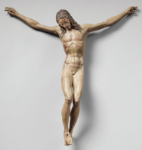
(presumed)
Let me say this once again: Jesus knew — Jesus had to have known — that Judas would lead Pilate to him (“What you are going to do, do quickly.” John 13:27); he knew that Pilate wanted him dead; he knew he was not a Roman citizen, so crucifixion would be the way; he knew Pilate had not yet found him, but sending Judas to Pilate would fix that; he knew he had time to escape, but probably not a lot of time; he knew that the smart thing for him was to hold Judas, and get out of town … now. And knowing all that, what did he do? He ordered Judas to go to Pilate.
Why?
My guess is that when he tells us You call me Teacher, and rightly so, for that is what I am
(John 13.13), he means for us to understand that everything he says, everything he does, is a lesson for us, for you and for me, for all creation.
The horrific occurence at Golgotha is a classroom event at which we are the students. And the lesson is, even after a harrowing death of the body by crucifixion, he is alive. Not dead, alive.
And lest we miss that truth, he proves it by appearing to Mary Magdalene (John 20:11). And then to the others, including doubting Thomas.
The more I ponder these events, the more I hear him telling me, telling us, Get past the blood and gore, and focus on the point, which is (I am now convinced), our life begins long before (infinitely before?) the birth of our physical body, and continues long after (infinitely after?) our body’s physical death.
In a word, like him, we are infinite. We were ALIVE before our physical bodies were born and we will be ALIVE after our physical bodies die.
Of course, we — well, speaking for myself alone, I — do not understand precisely what those words mean, but increasingly I am convinced that that is what Jesus — like so many other Teachers — is Teaching us. And I trust him. So I believe him.
He chose (generated?) a barbaric death to get our attention. And it worked. Who among us, whatever our preconceptions, can claim not to have noticed.
But now he urges us, Don’t memorialize my body’s death, instead celebrate my uninterrupted life, even as Mary Magdalene does, exclaiming, clearly joyfully, Teacher!
(John 20:16). We see him suffering. He sees himself teaching, Teaching.
Like so much of his life, for those who are listening, Calvary is a classroom, he is the Teacher, we are his pupils. (Matthew 13.9)
The question is (like so many lessons), are we paying attention?
Learn from me in this unmistakable moment, I hear him telling us, and you will set yourselves free.
All that is asked of us is that we listen.

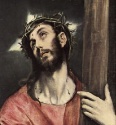
By El Greco
Let’s go back for a moment to Jesus/Issa’s mindset as he faced Pilate and crucifixion. My natural instincts are that he would be scared-stiff, just as I would be, as any of us would be.
And in their depictions of him carrying the cross, most (all?) Renaissance artists paint his expression that way — in misery. But when Pilate asks him in Luke if he is a king, his response does not echo fear; he responds “So you say.” To me, that does not sound frightened, more audacious, even in-your-face.
Here is my point: Jesus is a Teacher. And, again, if you have not done so yet, please follow that link to read what I mean by the word Teacher. A Teacher is not subject to misery or regret or alarm or fright, especially in a classroom circumstance that he himself generated. Yes, the Renaissance art is beautiful, powerful, inspiring. But in Truth (as I perceive it), it is fiction.
… The crucifixion is the reason for the Incarnation.
Peter Kreeft
…our life begins long before (infinitely before?) the birth of our physical body, and continues long after (infinitely after?) our body’s physical death…
What if, as is increasingly evident to me, there truly is only one life, One Life? The one and only infinite indivisible consciousness. That and nothing — no thing — else.
Our personality, our separate identity — Stefan and your name — are simply momentary (physical birth to physical death) phenomena.
And if during that physical life we do not reach Self-Realization, then presumably (maybe, possibly, likely) we continue the sequence of birth to death until eventually we do in fact achieve Self-Realization. Like an academic calendar: classroom attendance (physical life) fall through spring, and then summer off. Repeatedly, academic year after academic year. Until we graduate.
But here’s my wonder: Okay, there is only One Life, and each of us … and every tree, mouse, blade of grass, ski slope, cloud, planet … is a manifestation of that One Life. We begin like uneducated — that is, un-Self-Realized — again, think students and an academic calendar — and we continue as long as necessary. But we are not individual separate beings. In some way I clearly do not understand, we are manifestations of the One God learning (?) how to be What We Are in Truth.
So, the entirety of what I call my life — the body I call Stefan, the desk and computer on which I am writing this stuff, the window through which I see grass and trees and birds, the sky above, the thoughts in my head, you and others … this and everyone and everything else — is a single whole, and I am that. Mind you, not “Stefan is that,” but that is “Stefan” and your name here. That is, in some way I am unable to articulate Stefan (your name here) is/means/equals an entirety which, for the moment we know of as Stefan‘s life (your life) is the entirety … for learning purposes. Again, my life, your life, is in its entirety a classroom experience. I am not living my life; I am my life. My life is me. Ditto you. And embracing that, ingesting that, allowing that, is a synonym for the spiritual path
each of us is treading.
I am that; you are that.
After all, if God is Infinite — and if God is not Infinite, then God is not God — then God by definition is All There is.
In other words, there is only one Individual Being
. Call it God, call it Brahman, call it Allah. Or don’t call it at all.
And somehow we are That being me and you.
Mind you, we are talking here as if
— putting anything spiritual into words is as if.
Metaphors, figures of speech, word painting.
We do our best to speak it, but however well intentioned, it is unavoidably too shallow, too little. In a word, if it can fit into our minds, it‘s too small.
November 10, 2023
See my thoughts about awareness here. Consider too this conversation among Jesus, Judas, and Mary Magdalene, and my consideration of the Landscape Mode.
I am, and likewise you are, the Infinite Indivisible Eternal Self (let’s say God) imagining (let’s say dreaming) that I Am a finite distinct person (let’s say you and me) living in a finite, diverse, mortal world (let’s say here).
And as long as we Realize that Truth, all is well. We constantly Know ourselves to be an Infinite Being living a finite life, an Immortal pretending to be mortal. But the moment, the very instant, we forget That Truth, what each of us now knows as my life and your life becomes just that, my life and your life. In a word, all hell breaks loose.
That is the Truth of What Is. And only that can set us Free — embracing it, remembering it, ingesting it, knowing it, becoming it.
Every religion, every tradition, every belief structure, every spiritual path, every yoga, will take us there. But it demands self-effort, commitment, enthusiasm, and earnestness.
But let us be clear: This is not a task we achieve. It is not something that we do. It seems the most we can do, the least we must do, is get out of its way. This is something that wants to happen, even that God wants to happen. But we are the obstacle. Our certainty that I am some body and you are some body, distinct from every other body and every other thing, that conviction is the obstacle. And there is evidently no way that the egosense — our conviction of ourselves as you
and me
— can do that.
So how does it happen?
God knows.
Consider this: Some traditions Teach that the reason we are here is precisely to learn what I just wrote and you just read. That is, our mortal life is a classroom, and the curriculum is learning who and what and where and why we are.
October 30, 2023
I Am That I Am
Exodus 3:14
In some traditions, the universe is God’s body. If so, earth is a piece of, an aspect of, a reflection of, God’s body.
In 1997, President Jimmy Carter warned us about global warming and its inevitable effects on the planet.
We ignored him. Yea, we did one of these, and two of those, but effectively we did nothing. Just so, the man who followed him as president removed the solar panels Carter had installed on the roof of the White House. That was the example set to the world by the United States of America.
Gotta be honest, I did nothing.
But here’s the thing. What are the odds God did not notice my silence? Or that God is not aware of the damage to the planet that global warming (not to mention oil spills, over population, misuse of ground water, insane agricultural policies) inflicts on His body … if that’s what it is.
When my Time comes, how shall I respond to His inquiries about this? Geez, global warming? Well, I dunno, I mean, after all, the thing is, I guess, on balance, I just, well, you know, followed everyone else.
At that, I suspect St Peter is likely to tell me to take a seat, and think carefully before I speak again.
September 9, 2023
The universe is, as it were, the body of Brahman (God)
Vasistha’s Yoga
Me and My Mind
Thinking this morning about the state of the world, I came again to the realization that what I perceive in and as my life is a product of nothing other than me and my mind.
The world (my life and everyone and everything in it everywhere always) appears and unfolds — exists — according to who/what/where I believe I am.
And all of that is created and exists nowhere else but in my mind.
No exceptions.
My conviction that I am the body and the mind known as Stefan (to borrow words from Vasistha’s Yoga) determines my life and everyone and everything I experience in my life precisely as I experience them.
In other words, all of my life — everyone and everything — takes place in my mind and nowhere else.
My life and its inhabitants — the people and events that populate my life — seem to me to exist and occur outerly; that is, outside my body. But that is an illusion. In fact that is THE illusion that all the Teachers talk about.
That said, I suppose, I expect, that all of those people and events, all of them, all of that, have a reality of their own apart from me and my mind in some way that I do not fully understand or know … yet. And in some way I am unable to articulate now, I suppose I appear — where necessary or appropriate — in their lives created by their mind just as they appear in my life created by my mind. BUT how I experience them, the way I am experiencing them, the way they appear and behave in my life is determined and shaped and manifested by me in my mind, and nowhere else.
Just so, an experience, any experience, I share with anyone else occurs in my life nowhere else than in my mind.
My joy, my sorrow, my regret, my disappointment, my anger — as regards anyone, anything, anywhere, anytime — is sourced in my mind and manifested by my mind as my life.
THERE ARE NO EXCEPTIONS.
No one and no thing exists in my life, no one does or says anything in my life, that is not a product of my mind.
Every second of every day I am creating, in my mind and therefore in and as my life, everyone and everything and everywhere that I see, hear, feel, experience.
Again, there are no exceptions. No Yea, but …
So, if I am unhappy about anything anywhere, there is no point in whining.
Yes, to be sure, the ultimate solution is to transcend the mind, which is Self-Realization. But in the meantime, the solution is change my mind. And my life will, my life must, unfold accordingly.
And the way, a way, to generate that is to recognize, acknowledge, that whatever I am not liking is itself, like Everything Else, a personification, a manifestation, a reflection of Infinite Consciousness, the Divine One (always remember God is Infinite), and therefore harmless to what I am in Truth. Embrace that thought, turn that thought into the atmosphere, the underlying attitude, of my every day life, and my mind will change which will change my life.
Piece of pie, easy as cake — a favorite line spoken by a Russian astronaut character in the movie 2010 odyssey.
Of course easy is exactly what it is not. But it can be done. Ultimately, it will be done. It is what being a spiritual seeker is all about.
Reality exists in the human mind, and nowhere else.
June 16, 2023
See also here.
Distrust your mind, and go beyond.
Sri Nisargadatta Maharaj
I could be wrong, but so it seems
A discussion among friends generated this consideration:
Life as we know it is a school, a Curriculum. There is only one subject: Life, learning how.
Like school, it is a continuing continuous process.
At any given time, some of us are in kindergarten, some in elementary school, some in high school, some in graduate programs. Like that, in school.
No level is better than any other. Each is perfectly suited to itself. We all go through all of the levels. The levels are different, but the subject is always the same. Being taught, being learned: Life, learning how.
We appear to one another more or less the same. And so we assume we are the same. But we’re not. Any more than an infant suckling is the same as a child learning arithmetic in elementary school is the same as a student of astronautics at CalTech. We are at different levels. Not better, not worse; just different. Younger, older. The differences among us are normal, natural, common. Just like school.
And just like school, we go from one grade to another. Sometimes, we repeat a grade. Sometimes we seem to take a year off. But no one skips a grade.
But unlike school, where age is clearly visible and apparent, here we cannot tell the difference among us. The growth is inner, not displayed.
The pace and the progress is only partly up to us. When we pay attention, we notice what’s happening, we react accordingly. We listen, we observe, we question, we seek. Other times we wonder about the process, but without enthusiasm or commitment. Or we pay no attention, and just fool around. The process responds accordingly. But my experience, my guess, my near-certainty is that it is pretty much, if not entirely, on its own — autopilot.
I say again, we&re in class, like school. We make choices, but we are not in control. The beat goes on … and on and on. All the while, the Curriculum is in train, unavoidable, inescapable, inevitable: Life, learning how.
We are never alone. Everpresent is patient guidance and encouragement. It&s in the System. It is the System. Thank God. A Guru, a Daoshi, a Minister, a Pastor, a Priest, a Rabbi, a Shaman, a Sheikh, a Swami. A Spiritual Friend, inner or outer, visible or invisible, recognized or not. A book. A lecture. A dream. An unexpected urge. A coincidental meeting. The Teacher is always Teaching. (If you have not already done so, please click on this capitalized word Teacher to read what I believe about that word, what I mean, what I am pretty sure about.)
And, yes, as I see it, this scenario assumes reincarnation, even many incarnations. We never die. The body dies, but we live on.
We return. In a different body. As many incarnations as it takes, in as many species and forms as it takes. Always in school.
Does that mean we may live hundreds, thousands, even millions of lives? I expect so. Does it mean we may live a life as a snowflake? Could be. A rock? Why not. Everything God’s.
Until what?
Here’s Meister Eckhart: If I am to know God directly, I must become completely He and He I; so that this He and this I become and are one I.
Which I take to mean: Eventually the pronoun i (lower case) — the ego, the separate and distinct I am me and you aren’t
perception — dissolves, disintegrates, diffuses, disappears into the One and Only upper case I, the One Than Which There Is No Other, as in Exodus 3:14: I Am The I Am
Then, but no sooner.
Mind you, this is not something we do. Or achieve.
As I see it, this is not like a high school or college class where, if we spend enough time and energy studying, we will excel. This is simply about growth — inner growth. And I suspect most of that goes on out of sight, despite us. Like the way a cocoon becomes a butterfly, a seed becomes an oak. What we can do is allow, enable, embrace, this spiritual process: render to God, surrender to God, our separate and separative sense of me and mine. But even that cannot be forced, much less faked, or maybe even necessary. Consider Paul on the road to Damascus (Acts 9): awakened after stoning Stphen.
Life, learning how.
Why? We are subject to the Magnet of the Universe (that) draws every living thing … moving … towards a definite objective
(Mysticism by Evelyn Underhill).
Best advice? In the words of Nat King Cole, Straighten up and fly right.
May 5, 2023
One who believes
that God can be reached by human exertion will
encounter endless torment;
and one who believes nearness to God can be attained
without exertion will encounter an endless wishful
dream.
Abu Sa’id al-Kharraz
in Sufi Heirs of The Prophet
What Is
God says to Moses, I Am That I Am
(Exodus 3:14) or, simply, I AM.
That I AM is Infinite, and so includes all that there is. God perceives Herself/Himself/Itself as the Entirety. When I say I AM, I mean I am all that there is, there being no other being or thing or whatever than I.
The Mind bites off a piece of that, and in doing so, creates the universe as we know it, which is the Entirety perceived piecemeal.
And so, as an apparent piece of the the universe, we — individual persons — refer to ourselves as i am
which is I AM
perceived separatively. When you and I say i am, we mean I am me not you, not that house, not that tree, not anyone or anything else. Separate.
The spiritual process is about undoing that. Erasing i am
and resuming I AM
. For which God created the eraser.
Just so, many of the Teachers urge us to meditate the query Who am I?
As seekers, we inescapably do that from the perspective of i am, the separate individual we perceive ourselves to be (that is, the body). But the promise of this spiritual instruction when performed regularly with enthusiasm is transformative. Our sense of self as the ego (I am me and you aren’t
) is lifted to the Self, the Infinite One, the I AM, which exists now and always, but which somehow has become hidden or veiled or whatever from our awareness. (For a consideration about that, please see In The Beginning
here.)
By the Grace of God.
January 29, February 2, 2023
I Am the savor of waters, the radiance of the sun and moon …
the sweet fragrance in earth, and the brightness in fire.
In all beings, I Am the life.
Bhagavad Gita 7:8&9
This I Command
There are two statements — dicta — that have come to define my spiritual practice. In this context, I use the word in both of its meanings and spelling, as a noun and a verb. That is, ‘My practice is to awaken between four and five in the morning to practise stilling the mind.’ (Please note: In the US, both the noun and the verb form are spelled with a c, as practice. Here I chose the Canadian spelling for emphasis and for fun. Speaking as one who lives in Maine, it's impossible not to love Canada.)
The dicta are “This is I command you, love one another” and “God is Infinite.”
Okay. Issa (Jesus), as do all Teachers, commands us to love one another (John 13:34). I confess, for much of my life, I took that to mean love those whom I like, or feel that I should like; but those who are clearly not lovable, who are genuinely hateable, are exempted. I figured Issa (although then to me he was, of course, “Jesus”) couldn’t have meant for me to love them too, right? I mean, is it possible that Issa loved Pontius Pilate? Really?
But then there is the other one, God is Infinite. Although I have found nowhere in the Bible saying specifically “God is Infinite,” Psalms 139:7ff is close enough. Besides, virtually all of the Teachers in all of the traditions start out with that. Figures. If God isn’t infinite then God isn’t God.
Okay, infinite. We all know what that means, don’t we? Well, just in case, here it is: if God is Infinite, then God is All There Is. In turn,  that means, if God is All There Is, then all there is is God … because, again, God is all there is. In other words, there is no one, no thing, no where, no when, that God is not. Why? Because God is Infinite. Whatever any “it” may be, if God is not that, then that does not exist. Infinite allows no boundaries, no borders, no dimensions. Whoever, whatever, wherever, whenever there is, it is God — because, I say again, being Infinite, God is all there is. There is nothing anywhere that God is not … including Issa’s reference to “one another.” Here is a sentence from what I call The Sacred Riddle, “if You (God) are Infinite, You’re occupying all the space, all the time, there is, leaving not so much as a microsite for me” — or, I might have added, anything else.
Recent newspapers across the globe have run stories about Vladimir Putin bombing maternity wards, hospitals, schools, shopping malls, railroad stations, food depots, day care facilities, fresh water sources, civilian utilities. Yes, I know, war is hell; but Putin has taken his war in Ukraine to a heinous level. It is almost impossible for me not to hate him, never mind love him. BUT (and it’s a big but), if God is Infinite, then Putin and what he is doing … I can barely get myself to write it, is somehow God being that, somehow Divine. How do we square that?
I mean, if God is Infinite, then God is All There Is. Nothing is excluded, because if anything were excluded, then God is only sort of infinite or mostly infinite. And yet, it is easy for us to acknowledge that Teresa of Avila is a product of the Divine, or is in some way Divine herself, Lao Tsu, too. But Putin? Give us a break, Issa!
But consider this: If I stub a toe, maybe badly enough to break the nail, cause bleeding, even require a cast and a crutch, then I will be disappointed, even angry, especially if I have plans to ski this afternoon. But will I take out the anger on my toe? Will I hate my toe for what it has done to me? Of course not. On the contrary, I will care for it, pay special attention to it. Why? Because that toe is a part of, an element of, my body. And if I love myself, as we are all urged to do — in a mature way, then my love has to include that toe, right? In some sort of similar sense, a sense that I cannot (that I refuse to?) recognize, Putin is an element of, a part of, God’s Body. I mean, if you and I are, then so is Vlad. At some point, my reaction to that will be — and some moments even now it is — “Well, of course.”
Love one another. Let’s consider the word love. The Greeks were good with words. They had seven or more for love. There are three of interest here. First is “Eros,” which is hot love, sexual love. Any of us who have been through puberty know about Eros. I remember one Spring day in high school, during Miss Darrigrand’s advanced algebra class, being snared by a thought fantasy involving a girl in a nearby seat wearing a see-through blouse. That’s Eros. When Issa said “This I command you, love one another,” I am pretty sure that is not what he was talking about.
Philia. This is close. In American English, Philia is normally translated to brotherly love, but I have read that the Greeks use it more to mean friendship or affection. I like the word, and maybe Issa did too. But I think He was reaching deeper.
Agape (ah-GAH-peh). Yup, it’s Greek. As I consider it, that level of love is effectively indefinable, even inexpressible. A Google search of the word reveals lots of references to God’s love for man and man’s for God. I get that, and I agree; that’s hard to beat. But digging deeper, a search suggests Agape is relationship in its truest, most enlivening sense, which in turn brings up the love addressed in 1 Corinthians 13:4, which surely approaches Agape: “Love is patient, love is kind; it does not envy, it does not boast, it is not proud.”
But, with due respect to Corinth, I perceive Agape as more than that. Agape is neither deliberate nor intentional, and certainly not accidental. Agape doesn’t happen, it reveals itself. We do not choose Agape; Agape chooses us. Agape is deep, profound, uninterruptible. Agape has no boundaries, no commandments, no requirements, no demands, no regrets. Agape heals, fixes, restores. It is a wondrous, calming, uplifting, breath-giving and breath-taking love. My guess is, when we say “God is Love,” or when the Beatles remind us “Love is all we need,” that’s Agape. And when we say, “To love, honor, and cherish, until death do us part,” Agape is what we are talking about … and hopefully mean.
When we are truly praying to God in a heartfelt manner — alone or with a fellow human, or even with a beast (remember, God is Infinite) — that is Agape. Agape is not something we give or offer. Agape is not something we do. Agape is what we are. To my ear, Agape is God’s Grace: boundless, timeless, powerful, healing, resolving, majestic, comforting, miraculous, free — and then some. Our function as spiritual seekers is to open ourselves to that, all of that. Just so, Agape — enthusiastically allowing it — may be all that the spiritual process is about: Getting ourselves … me, my, mine … out of the way.
Surely, Agape is what Issa has in mind, Himself indisputably fully conscious of God’s Infinite Being, when He commands of us, love one another. Whenever I read those words, I hear Him adding, and I mean, now!
I said the dicta that haunt me are “This is I command you, love one another” and “God is Infinite.” Wrap those two into a single seamless One, and what have we got? “This I command you: Love God Who Am you and she and he and they and this and that and these and those whatever wherever whenever without end. Now!”
To which all the Teachers assure us, “Did I say it was going to be easy? No, of course not. But if it can be reached by anyone, it can be reached by everyone.” It will be.
Amen
On the subject of hate, consider these lines from Martin Luther King, Jr : “And I say to you, I have also decided to stick with love, for I know that love is ultimately the only answer to humankind’s problems. … For I have seen too much hate. … and I say to myself that hate is too great a burden to bear.”
December 6, 2022
If God is Infinite,
then by Definition there is only one God,
The One God.
And all roads lead There,
there being No Where Else.
TZF
He is the universe
though the universe is not He.
Vasistha’s Yoga
This morning, contemplating some of the ideas expressed and referenced in the past few days’ entries below, along with Issa’s (Jesus’) command that we love one another (John 13:34), generated once again a realization that Stefan and Stefan’ life — and you and your life — are an answer (or a partial answer) to God’s question to Herself (Himself) asking “Who Am I?”
A reminder: The premise of my book In the Beginning is that God, being Infinite, is unable to see Herself, so, in order to accomplish that, She creates a prismatic mirror, and perceives Herself in it as separated, diversified, manifested stuff; to wit, us. Or alternatively, God manifests Herself as Adam, puts Adam to sleep (Genesis 2:21), and dreams Herself as us. Either way, She experiences Herself, and answers the question Who Am I? (Is it a coincidence that all the Teachers constantly urge us to ask ourselves that very same question?)
Anyway, stirring all of that this predawn, here’s an image I came up with. Yes, it is a little cartoonish, but stay with it anyway.
Living immediately behind me, separate but closer than close, there is an I, with all of it’s body parts in absolute synch with mine — if you have ever, perhaps as a child just for fun, marched with a friend in lock-step, the image I have is like that. It is not Stefan’ I (or, should I say, Stefan’s i); it is another I, in place now and increasingly evidently, there always. This is a Big Shot I — maybe not THE Big Shot I, but close to it. And it is experiencing Its Self by observing and experiencing what Stefan calls “me and my life.” To Stefan, all of that stuff, including “me,” is just stuff — like, this morning, a comfortable seat, a small table, a rug, a potted plant, a dozing cat, a window, part of another house perceived in the window, and like that. But (and what a BUT this is!), to the synched I, it is Its Self! That Synched I (or is it, That Synching I) sees Its Self through Stefan’ eyes — Its Eyes being synched with Stefan’s eyes.
Now, with that image in your mind, consider the activities you have planned for the next few hours. All the stuff you are going to do. And just for fun, apply this cartoonish image to it. You’re brushing your teeth, but (yes, that but) you are not alone. You are being watched; or is it, you are being experienced. You’re taking a shower. You’re peeing. You’re dressing. You’re making breakfast. You’re reading the morning newspaper. You’re reacting to the morning news.
Wait a second! Did I say reacting? Who’s reacting?
Whose life is this life i am living? Is everything i have done, am doing, will do, just a product of The Synched I asking Itself, “I wonder what it feels like to have oats for breakfast? … to pat a dozing cat? … to look out a window? … to read a newspaper?” Try applying this thread to your plans for today, as I assure you I have been doing all morning. This takes to a new level the assurance by all the Teachers, “You are never alone.”
Jesus (Issa) said, “The Father and I are One.”
Is this some of what He meant?
At the top of this post, I mentioned the Command that we love one another. What has that to do with this? Well, if what each of us calls “me and my life” is at some Level the very thing He is experiencing as His Life, then I am not sure our rejection of it, even any of it, is good Karma.
December 3, 2022
And the beat goes on.
Sonny and Cher
Witness & Ego
Virtually all the books talk about the Witness and the Witness Position. As I understand it, the Witness is our so-called Higher Self, the Reality that is not tied to the body we think we are inhabiting. So what is the Witness witnessing?
As I see it, the Witness is not witnessing (observing) me and my life, Stefan and Stefan’s life.
The Witness is witnessing Its Own Reality, which is the Entirety. Stefan’ horizon is a matter of miles. The Witness’ horizon is Infinite, Boundless.
Again, as I see it, the ego is witnessing or observing Stefan and Stefan’s life. In fact, it is the ego/mind that created Stefan and Stefan’s life. Bundled together a basket of senses and memories, labelled it “Stefan” and “me,” and here I am, that.
In the spiritual adventure, the ego has a bad reputation. Indeed, the ego is considered the enemy. But that may not be fair. Our mistake is not having an ego; our mistake is mistaking the ego for the Self. The mistaken perception is “I am Stefan,” when what we should be Witnessing is simply “I Am.”
Once again, as I see it, every aspect of reality — every element of what Stefan calls “my life” — has an ego, including of course the body/mind labelled “Stefan.”
Why? Because the ego is an aspect of being an aspect of Reality. Think about it. In a struggle, a lion fights for its life, not the antelope’s life. Ditto the antelope. An ant carries a crumb to its kind, not to you or me. We call that instinct. I suspect that, cosmically speaking, instinct is another word for ego.
I know, the ego is evil. Every seeker knows the Eleventh Commandment, Thou shalt slay thine ego.
But why do we say that? We say that to shift our sense of identity from the body — in my case, the body named “Stefan” and the body’s life — to … our True, Infinite, Nameless, In-All-The Universe-There-Is-Only-One Self. In many such cases, the body still remains, but it is no longer “I.” However, it still knows not to step in front of a moving train. In other words, it still has an ego/instinct.
So, is it possible that the ego is simply the being’s (notice, please, the lower case b) survival tool? It is evil only if we mistake it for what it is not — and was never intended to be! If so, then it is not evil; we are, uh, careless, foolish.
Maybe in animals we call the ego instinct because we do not want to consider that animals are like us, or we like them. If apes have egos, then Desmond Morris’s title The Naked Ape is apt. And that makes us uncomfortable. In Sunday School we are taught that we are special, even chosen, not just naked apes. We like that.
But, again, what the Witness is witnessing is the entirety, the Entirety. And the Witness Realizes that everything it sees is the One Self — ultimately Its Self. To the Witness the only difference between me or you and an ape is the appearance, and that is only apparent. We are all one Thing, and that One Thing is the one and only One.
So, yes, of course, we care for our body … the same way lions and antelopes do, and so we should. But here’s the thing, the spiritual seeker thing: REMEMBER WHO IS DOING IT! (Here’s a thought: Do lions and antelopes need to be reminded of that? If not, why not? Why do we, and not they? Yea, yea, The Fall.)
Self-Realization is also Awakening. And in this context, Awakening means being constantly Aware of What is Happening … and by Whom to Whom.
All of this raises the question: If lions have egos, do other living things, like trees? like stones? When the Pharisees told Issa (Jesus) to quiet his cheering supporters, how did He reply? “I tell you, if they keep quiet, the stones will cry out.” (Luke 19:40) Was he exaggerating? Was he speaking in metaphor? Well, here are a few words from Nisargadatta in I Am That (page 98): “… the freedom of the stone … Freedom unlimited and conscious.” And again, “Even stones are conscious and alive.” Or these lines about Babaji in By His Grace (page 43): ”He talked about the sanctity of the place, how Rama had sanctified the whole place by His presence. Each and every stone bears his footprint on them. … ‘Rama is present in each and every particle.’” And still again, Ramana Maharshi; in a discussion about ahimsa (non-violence), a questioner observes that even plants have life, to which Ramana answers, “So too the slabs you sit on!” The word slabs sounds to me like stone.
I know, it’s not that simple. But for me it is increasingly apparent — increasingly evidently True — that Life is all there is (God/Life is Infinite), and if that is so, then in some way, some way that, yes, I do not yet fully understand (I know it but I do not Know it), every apparent thing is alive. Including rocks and stones. And I like the feeling that generates in me.
November 11, 2022
Now, try this for fun: Standing or sitting in a room or in a field — or anyhow anywhere — look about you, and at every thing your eyes fall on, say to yourself, silently, gently, firmly, enthusiastically, convincingly, “I am that.” Then, after a bit, expand your mind’s horizon to include all that you just addressed and whatever else comes to mind, and affirm, silently, gently, firmly, enthusiastically, convincingly, “I am this.”
Do it fervently enough, often enough, and sooner or later you may hear yourself remembering Exodus 3:14: “I AM THAT I AM.”
Contemplate that.
November 17, 2022
Sitting this morning, this item about the ego boiled up.
The Teachers tell us that the inescapable question a spiritual seeker has to unfold and address is, “Who am I?” Why? Because the reason a spiritual seeker is a spiritual seeker is that all of us (albeit unawaredly — I know it is not a word, but it ought to be) are answering that question incorrectly.
We say “I am this body“ not because we are foolish or stupid or lying but because that is who/what we honestly think we are. “I mean, look in the mirror!” But again, we are wrong. Well, not exactly wrong, because … Actually that’s the thing that boiled up this morning …
From the day Nancy and I started reading the Teachers, and ingesting their Teaching, the question, “Why do we think we are the body we seem to be inhabiting?” has bubbled about in my head. Yes, all the Teachers insist rightly that our True Identity is not limited to the bag of flesh and bones labeled _______ (fill in that blank with your name). And when we — by the Grace of God — are Self-Corrected out of that nasty habit, we Realize “Of course!”
But here’s the question that needs addressing: Why? Why do we mistakenly identify ourselves with the body? The theological answer is “The Fall!” God gave Eve and Adam a gorgeous condo in a spectacular neighborhood, and what’d they do? Duh! They ate an apple.
Really?
Or the almost reasonable answer: At birth, an infant is, in effect, Realized: opening its eyes the first time, for all it knows, all that it sees is Itself. “Oh, look at me!” Mom and Dad and others immediately, lovingly correct Baby: “No, dearest one, I am mommy, dad is daddy, physician is her, nurse is him” and so on, until our first impression is, well, corrected. And the rest is history.
But the question “Why?” remains unanswered.
Just so, the premise of my book In the Beginning is that God, being Infinite, is unable to see Himself. I know, God is Perfect, so no faults; but think about it, from the perspective of an Infinite Being, there are no boundaries, no me or you or this or that. Everything is What Is, Me — that is, God — so there is no way God can say to Himself, there being no others, “I am this, not that”. So, from the book:
… if there was nothing that was that was not God, then God would not have been able to differentiate between Himself and anything else. There was no anything else. There was nothing to which God could point and say, “I am God and you are not,” thereby indicating for His own edification at least, which was which. That is, I perceive that I am me in part (some say, wholly and only) by perceiving that I am not you. Thus, “Me Tarzan, you Jane” informs both parties. My perception of your existence separate from mine creates mine, or at the very least affirms it.
So God does what? She creates a Way for Her to see Herself … and how does She do that? She creates an environment in which there is a “you” and a “me” and an everything else separatively. Which enables Her to look in a mirror, and exclaim, “Wow! Look at Me!”
In other words, our being (Being?) here is not the result of a God-forbid Fall of which we are, every single one of us, eternally guilty and forever atoning for. It was, it is, the product of, can we say, Day Eight of Creation. Which makes the Creation of Day Nine inevitable: Self-Realization. On Day Eight, God created what each of us calls me and my life, and on Day Nine, He Created the Eraser to undo Day Eight!
Of course that is a lot of nonsense. But, remember it is a metaphor, intended not to be True but to be Clarifying.
November 18, 2022
Let’s say some of this again. In all the Universe (by which I mean, not the astronomical universe, but the Cosmic Entirety — What Is) there is only one I — the I as which and about which God informed Moses: I Am That I Am (Exodus 3).
That is the only I there is. How do we know that? Because that I is God, and as we have established, to be God is to be Infinite. (That is, if God is not Infinite, then God is not God, but God is God.) So, God being Infinite, then by definition, everything about God is Infinite, because, again by definition, Infinite means having no boundaries of any kind, anywhere; no “this but not that.”
Which means that God’s “I” is Itself Infinite. Which, in effect, makes God’s I the only I there is.
Which means that when you or I say something like “I am me” or even “I’m late, I’m late, for a very important date,” the I we are asserting, even if in song, is the One and Only I there is.
Yes, the circumstances surrounding our singing a tune are different from God introducing Himself to Moses, but, that said, they are in fact the Same. Here’s the Thing: When God uses the pronoun I, She knows Who She Is, and so there is no confusion about it. When we use the pronoun I, our mind attaches it not to the Cosmic Entirety, but to the bag of flesh and bones we seem to be inhabiting. It is a simple case of Mistaken Identity.
But is it a mistake? As I have written here and elsewhere, I believe it is not an error because, again, as I have written and said, if God is God then God is Perfect, and if God is Perfect She makes no mistakes, and if God makes no mistakes, then, God being all there is, there’s no such thing as “mistakes.” You and I cannot do anything that God has not Created … and Allowed.
(Aside: Over the years, from time to time, I have been asked to stop using three pronouns for God, as I do from time to time on TZF: She, He, It. “It’s confusing. Make up your mind!” Well, that’s just it, isn’t it? Whether God is male, female, neuter, or all of the above or none of the above, is not really a matter for my mind to resolve. I continue to waiver because the mind is devious and a creature of habit, ignoring which will serve me poorly on the day I meet St Peter at the Gate. “So, Stefan, God is male, you say? Are you sure you don’t want to reconsider that before I make my Decision?”)
Anyway, when a child believes in the existence of Santa Claus and flying reindeer at the North Pole, is that a mistake? Not really. A child believes such things not mistakenly, but because she or he is a child. Just so, when we use the pronoun I as referring to me it is less an error than childlike. We are young. When we age and mature and are Graced with Realization, we see the same things differently.
As for the use of I meaning me (Stefan), I visualize that I as a lower case i. It is still the same I spoken in Exodus — there being only one I in all the Universe — but youthful. Or, a lower case i is I spoken by a character, me, appearing in Adam’s Dream. Remember, God put Adam to sleep while Creating Eve (Genesis 2:21), and we are not told when God awakened Adam. Just so, I suggest that Adam asleep is not awakened until he is baptized by John The Baptist. At that event, Adam Awakens as Issa (Jesus), Self-Realized. Here is Matthew 3:16-17: “As soon as Issa (Jesus) was baptized, he went up out of the water. At that moment heaven was opened, and he saw the Spirit of God descending like a dove and alighting on him. And a voice from heaven said, ‘This is my Son, whom I love; with him I am well pleased.’”
Does that mean everything from Genesis 2 to Matthew 3 is the dream of sleeping Adam? Well, let’s not lose our heads. But, speaking as a seeker, considering it that way works for me.
November 22, 2022
This raises the question, “Is Adam still asleep?” In other words, was Issa (Jesus) the sole character in Adam’s dream, and so His awakening is Adam’s awakening, or was Issa only one of the characters in Adam’s continuing dream, which number would include the rest of us as yet unawakened?
Remember, this is a metaphor, so of course it does not fit the situation precisely. All that matters about a metaphor is, does it help to clarify or illuminate the situation?
If, as I suspect — based on the convincing Teaching of so many Teachers, Stefan and Stefan’s life is effectively a dream, then the dream continues. Which makes Issa (Jesus) — and Ibn ’Arabi, Nisargadatta, Ramana, et al, Teachers who choose to remain in the dream from which they are awakened in order to, well, Teach the rest of the dream characters (us) how to escape the dream as they did. To me, that makes sense … speaking metaphorically.
So, I repeat myself … again. My premise at In The Beginning is that God, as an Infinite Being, is unable to see Herself (being all there is), and so creates a device, let’s say a prismatic mirror, that in effect alters Her (in Her Mind’s eye) from One to Many — diversified; thereby empowering Herself to perceive Her One Self as many separate and separated things. For example, as Stefan and Stefan’s life, as you and your life, as birds and bees, as trees and bushes, and as all the rest of the astronomical universe (lower case u). ONE diversified into Its apparent parts. Similarly, doing it the other way around, recall Krishna giving Arjuna a divine eye, enabling him to behold the entire astronomical universe, with its manifold divisions, all gathered together in one, One.
Just for fun, here’s Mark Twain: “While you are in a dream, it isn’t a dream — it is reality, and the bear-bite hurts; hurts in a perfectly real way.“
Just so. Until you awaken.
November 29, 2022
When you change the way you look at things, the things you look at change.
Wayne Dyer
Here’s a sentence that woke me up this morning: “God is Being.”
Well, yes, okay, God is Love, God is Life … but Being?
Another thought accompanied the first: Do not try dismantling it, Stefan. God, being Infinite, makes Being a verb, a noun, an adjective. In other words, Stefan, do not try to conjugate it or decline it. (My childhood was endless Latin class.) Let it Be. Just see the word. Hear the word. Ingest the word. Being.
I have been saying for years — certainly ever since the birth of TZF, There is no God but God, and God is all there is.
Being sounds like that; but more than that, too.
A few minutes later, out of bed, sitting in silence in another room, this came: “God is not in this room. God is this room.” Wow!
Again, even that general idea has been all over The Zoo Fence from day one. But this morning it was, it is, alive. Say it to yourself, wherever you are, softly but forcefully, so you cannot ignore it: God is this room. God is this car. God is this field. God is this experience.
Not metaphorically. Not sort of. Not theoretically. Actually. Truly. Totally.
Again, I hear myself about to repeat myself, but this morning it sounds, it feels, fresh. All the Teachers and Gurus, including Issa (Matthew 28:20) and Nisargadatta, Neem Karoli, Ramana — all of them — tell us over and over again, “I am with you always.” And being Self-Realized, Awakened, Enlightened, Liberated, Christ Conscious (pick a word) as they are, they are by definition Infinite. So, when they say I am always with you, now I see that they do not mean they are in the same room or same place as I am or you are. They mean, I am that place, I am this room — precisely because, being Infinite, they are What Is. Whatever is, a Self-Realized Teacher is That.
This morning, I hear them saying to me, “I am this room you are sitting in. I am the air you are breathing. I am the thought you are expressing. I am the keyboard you are pounding.”
I am with you always. Even now. Even here. Even this.
I have said and I have written, “We are never alone.” In those very words, or words like them, numerous times on these pages. But this morning, this is different. It is the same, but it is different.
We are never alone. We all say it. And we mean it when we say it. At least, we try to mean it, we want to mean it. But if God is this room, if God is the floor I am standing on, if God is the clothing I am wearing, then I am not alone. Really. Ever. Not one bit.
Being.
Too cool.
November 4, 2022
Consider The Sacred Riddle.
November 18, 2022
Fix your heart on Me, give your love to Me, worship Me, bow down before Me;
so shall you come to Me. This is My pledge to you, for you are dear to Me.
Bhagavad Gita 18:65
I had a dream last night of a flying white horse. Like Pegasus. For the record, Nancy drove by a farm yesterday, and saw a large group of white horses standing together. Maybe the scene, as she described it, made an impression on me.
Anyway, the horses Nancy saw were real. Let’s say, flesh and blood real. But the horse I dreamed was not real. It was a dream. There was no horse, white or winged, in my bedroom. My horse, real as it seemed to me as I slept, was an image in my mind. No flesh, no blood. A thought.
Considering that image after awakening, I was reminded that that is what we are, a dream: a dream in God’s Mind. Many of the Teachers say that; but this morning, as I sat in silence, it was clear. Stefan and Stefan’s world are in God’s Mind like the horse was in my mind last night. God dreaming of Stefan dreaming of a horse. Ditto you and your world.
Mulling that, it dawned on me (once again) that nothing about Stefan — nothing about his life or his world — matters. I mean, think about it. Yes, there are people who interpret dreams, and take them seriously — like Jacob’s dream in Genesis — and undoubtedly there occur some dreams in some people that actually are premonitions or predictions. But I do not recall ever having such a dream (although, come to think of it, there was such a dream that may have influenced Nancy’s and my life — see here).
But dreams are just dreams, right? How often have I been told or said to someone, Don’t worry about it. It’s just a dream
? If we and our lives are just a dream,
albeit God’s Dream, why do we take them so seriously? Should we take them seriously?
Is this what we, as seekers, should say to ourselves when we read or hear about or experience tragedies — like wars and floods and earthquakes. Incurable, painful diseases. Market crashes. Terrorist events. If, as again, the Teachers insist, our lives are God’s Dream, a thought in God’s Mind, why do we not say to ourselves, Don’t worry about it. It’s just a dream
?
Mind you, as seekers we can, and should, say such things to ourselves. But surely we must not speak that way to others who experience such encounters. As long as they need comfort, comfort them we must. Like this.
October 22, 2022
Row, row, row your boat
gently down the stream,
merrily, merrily, merrily,
life is but a dream.
Source unknown
The implications of saying God is all there is,
as I do frequently at TZF, are many, even infinite. What it means to me is simply there isn’t anything else. It — whatever we call it — is literally, indisputably, all there is. It does not matter what we think we are seeing and hearing and experiencing, none of it is even remotely what or where we think it is. Indeed, in the pleasing words of J Fred Coots, For all we know this may only be a dream.
And seekers who are honest to themselves know that.
This morning, sitting in silence at dawn as I do, there popped into my head an observation by TZF’s own Brother Theophyle: The only difference among the world’s religions is spelling. Of course, most if not all of The Zoo Fence suggests that. But I cannot think where it is positively, unmistakably said.
So, if as we say here, there is no God but God, and God is all there is, then it follows that the fundamental purpose of religion, any religion, is to come to that recognition, meaning, in effect, every religion points to the same thing, and — properly, sincerely, humbly, earnestly, joyfully followed — leads to the same thing.
Yes, their parts may be spelled differently. But fundamentally, Theophyle is correct, spelling is the only real difference among them. If there is no God but God, and God is all there is, then every religion, whatever it may seem to be about, is about the one God, there being no other God but the one God, and whatever any religion may seem to be leading to, its goal is God, there being nowhere else but God to reach for.
What does this mean? Well, speaking as someone who was brought up attending Sunday School, it means that Christ was not a Christian. Neither was Christ a Jew or a Muslim or a Buddhist … or a fill-in-the-blank.
So, when Christ says I am the way, the truth, and the life
he is not telling us, either become a Christian or burn in Hell. Likewise, when YWHY insists you shall have no other gods besides Me,
he is not threatening us. Neither is Allah where the Koran demands obey Allah
(implying, and no other God
). And so on.
The function of religion is to nourish us, teach us, focus us, inspire us, motivate us, all toward discovering Who am I?
There are other elements, of course, but none of them is intended to alienate us from one another, to encourage us to beat up one another. Let’s face it, when it comes to religion, mankind’s history is pathetic. That is part of why, at TZF, we prefer the expression spiritual tradition to the word religion.
As a species, we should be ashamed of ourselves.
October 21, 2022
So much blood has been shed by the Church because of an omission from the Gospel:
‘Ye shall be indifferent as to what your neighbor’s religion is.’
Mark Twain
Tintinnabulation. That’s a word I have never spoken or written before. Yes, I have read it. And, of course, I have heard it.
Tintinnabulation. The sound of a church bell. Speak it out loud, and it almost sounds like a bell ringing. Say it two or three times repeatedly. Be careful, it may bring you to tears.
Yesterday, I did an extraordinary thing. As soon as I had done it, I regretted having done so. No, it is nothing awful; nothing causing any pain or harm to anyone. It was just like something I have never done before. (Editor’s note: Reading this on May 18, 2023, I have no idea what it’s about. I have left this paragraph in place just in case … but my suggestion to readers is, ignore it.)
This morning I woke up with the word tintinnabulation in my head. Of course, I went straight to https://www.merriam-webster.com/ (I confess, I miss the big heavy book. Old dogs ….)
As I thought about all of the above, Nisargadatta came to mind — (his name figured in what I did yesterday) — and there burst into my mind, clear as crystal, this:
There is the Self. Call it Allah, YHWH, Brahman, God, the Infinite Supreme Consciousness, Father, or Mother, or any word of your choice. But here’s the thing, everything else — and I mean everything else — is a reflection of That. Including Stefan, Stefan’s life, Stefan’s world, Stefan’s universe, Stefan’s God. Everything Stefan is, was, ever will be. Everything about Stefan. Everything Stefan ever thought or did or will think or do. No exceptions. And that is all there is: That reflection.
Ditto you.
All the theologizing, philosophizing, analyzing, mentalizing, sciencing I have done, we have all done. Is it a coincidence that today is trash day where Nancy and I live? The crew will come by later this morning to pick up our garbage. Oh my. The Gurus all say, I Am always with you.
Okay, yes. Reflection may not be the right word. I for one will be nitpicking that in the days ahead. But the concept, the idea, the whatever it is, is definitely IT. Like I said, clear as crystal.
Remember in the Gita. Krishna lends Arjuna his Divine Eye. And what does Aruna see? The same thing, the same world, the same everything he has always seen. EXCEPT — and what an except it is! — he sees it all as ONE. Where there were multitudes, there is now just one, the One.
The Guru says I am always with you. Of course She is. In Ramakrishna’s words, God Alone is the Guru. The Guru planted this extraordinary, self-evident (or should I say, Self-Evident) thought in my head this morning. Thinking about it now, it is no big deal. I mean, all I have said and written pretty much has been that. But this morning, it was, it is, different.
And the difference is what caused the accompanying tintinnabulation.
6:00 AM Eastern, October 17, 2022
The word reflection. It suggests duality — I stand in front of a mirror and in the mirror is a reflection of me. So duality: #1 which is me, and #2 which is a mirror. Not to mention #3 space between #1 and #2 … and all the stuff next to and behind #1 that is also reflected in #2. So, reflection is out. Too busy.
Try this. Imagine a chocolate bar — Hershey’s, Perugina, Ghiradelli, whatever. See it in your mind’s eye. Is it real? Well, in your mind it is. But that chocolate bar does not exist outside your mind — like in your mouth. Although, if your imagination is really at work, that mental chocolate may generate salivation! That’s getting to real.
Play with that thought for a while. Walk it around the block, so to speak. And then come back.
That is how God creates. In His Mind, She imagines me, you, the planet, the universe, computer programming, wildfires, theorizing, digesting, thinking. And He imagines all of those apparent items relating to one another. Me talking with you; you reading what I am writing; each of us digesting a shared chocolate bar.
Extend all of that as far and wide, in every conceivable direction, as you can, and then allow that it actually extends far wider than we can imagine. To Infinity and Beyond. All in God’s Mind.
That is where we are. That is Creation.
Beyond that is … what?
Again, we are like a chick in an egg. The egg inside the shell consists of, contains, what to the chick is life, the world, the universe, and of course itself. All there is, for all the chick knows.
Beyond the shell is … what?
At some point, the chick starts pecking at the egg’s shell. Just as you and I are doing now. To what? To whatever is beyond the shell … to Whatever is Beyond God’s Mind!
10:14 AM Eastern, October 17, 2022
This theme — word? it’ll do for now — is stuck in my head … in a good way. The question constantly arises, as all the Gurus, East and West, endlessly insist we ask endlessly, Who am I?
and today it leads to recognition that the I that I think I am (Stefan) lives inside the eggshell. Stefan
is an element of God’s Thought. That is, creation — Creation — is a single whole, an undifferentiated, undivided one thing, part of which or an aspect of which is Stefan. Stefan’s body, life, etc. is not a separate entity in God’s Mind. There are no separate entities in God’s Mind. Stefan is a particle of the entirety. Stefan
seems separate from all the rest (I am me, and you aren’t
) precisely because, as explored in In The Beginning, that was the Plan, an Infinite Being’s way to see Itself.
So, when I say, Whatever is Beyond God’s Mind
what do I think that is? If Creation, as some put it, is God’s dream, then what is it that God sees when She awakens from the dream? What do I look like there? Clearly, as, again, all the Teachers Teach us, there are no separate I's or me's There. But those who seem to us to be there, to have Awakened there — who are Self-Realized or Christ Realized, like Ramana Maharshi and Issa (Jesus) — do seem to project, in their Teaching, separate identities. One of whom, I do not remember who, said, in effect (not a quote): I am not a separate person, and do not seem so to myself; it is only to you that I seem so.
Do we project what we perceive about ourselves onto everything we perceive? Is life really, actually, just a mirror? Duh!
I take that to mean, when a voice from Issa — or others like Him — tells us, I am the way, and the truth, and the life,
that is not a metaphor. From his perspective, the way the truth the life
is, yes, precisely what he is. The person, the body, the lad Issa from Bethlehem, died on the Cross. What lives, what is always alive is just that, the way, and the truth, and the life — also known as God. He looks like the man Issa to us because that is because we are seeing Him from inside the eggshell!
Just so, as I waited in line at the grocery yesterday afternoon, I paused, looked around, took it all in, and reminded myself, This is not what it seems. This is all an aspect of a single Thought taking place in God’s Mind, Stefan inside an eggshell.
And then I asked myself, Is this Single Thought all there is? Is everything I know, everything I remember, everything I think I am and have been, actually all taking place right now in this single thought? The two people in my dream last night were adults. Did they have a childhood? Did I?
The only way to answer questions like that, all the Teachers tell us, is get out of the eggshell.
10:43 AM Eastern, October 18, 2022
Hence, the Sanskrit term Sadhana, meaning, in our words, the entirety of a seeker’s path — all the practices, the postures, the language, the clothing, the diet, and so on which, taken together, comprise the path or the way each of us has chosen (or, perhaps, by which each of us has been chosen) … undertaken with honesty, devotion, determination, thoroughness, earnestness, enthusiasm, and joy.
In a word, once again, the Lord is My Shepherd, I shall not whine. As always, so easy to say, so difficult to practice!
1:45 PM Eastern, October 20, 2022
Though this creation is unreal, yet on account of the emergence of the egosense it appears to be solidly real. The dreamer does not realize the evanescence of the objects seen in the dream; even so, it is in the case of this cosmic dream of the Creator.
Vasistha’s Yoga
Or, each of us is an unreal dream character in an unreal dream having an unreal dream.
SCN
Last evening I read in I Am That, page 382, Nisargadatta saying, … if you learn to look at your consciousness … in which you are enclosed like a chick in its shell, out of this very attitude will come the crisis which will break the shell.
Here is the way that sounds to me: Stefan and Stefan’s world and Stefan’s life — that is, my consciousness — exists or manifests or appears (word?) in a chunk (word!) of the Infinite Supreme that is separated
from the Undivided and Indivisible Whole by an illusory barrier, and within that apparent barrier there is (appears, seems to be) diversity that causes the Undivided and Indivisible One to be perceived, instead of as One That It Is, as many; to wit, as you, me, persons, horses, trees, cats, clouds, cars, computers, health, illness, loud, silent, hot, cold, tall short, life, death, me, mine, past/present/future, and so on like that.
Existence inside that barrier is the illusion. There, I — we — perceive everything, including ourselves, precisely as it is not. Nisargadatta suggests we think of it as a chick's egg. We are the chick. Like a chick, we are born there, and we live there, comfortably in the warmth and protection provided by the feathers of the Creator wrapped around our egg. Until one day, we are moved to peck at the shell, and we do.
All of that is our life, including our progress along the spiritual process. Living inside the eggshell, eventually wondering about the eggshell, and finally pecking at the eggshell.
Nisargadatta says, … out of this very attitude will come the crisis which will break the shell.
To me, attitude means wonder, question, practice, meditate, contemplate, consider, discriminate. Each of us will choose, be chosen by, a way suited to us. The more intently and earnestly and sincerely we perform all of that, the more energy we will generate, energy which vibrates, pecks, against the shell, causing it finally to crack and fall apart, leaving in its place What Is and Always Was.
Matthew 27:51 uses the word veil not shell: … the veil of the temple was torn in two from top to bottom.
Bhagavad Gita 11:13, There, in the person of the God of gods, Arjuna beheld the whole universe, with its manifold divisions, all gathered together in one.
Neem Karoli Baba (known as Babaji or Maharajji), Today I am released from Central Jail.
In whatever language, in whatever culture we speak it, even whether or not we speak it, Truth is True.
What I take from this reading is, wherever I am, whenever I am, allow a few moments to perceive in my mind, in my heart, myself pecking against the shell. I urge you to do the same.
… out of this very attitude will come the crisis which will break the shell.
Nisargadatta says so. And He ought to Know.
October 8, 2022
Choices have consequences.
This morning, reading — for the umpteenth time — somewhere in I AM THAT (I regret I do not remember the page number), I came away with this (my words from memory, not Nisargadatta’s):
The Infinite Absolute Self projects Its Sense of Self-Awareness (“I AM”) onto my mind, and my mind mistakenly (as I recall, his word was more like carelessly) attaches that awareness to the body, generating my conviction “I am this body.”
Making a seeker’s task simple: Undo that attachment!
Mind you, that’s simple, as in uncomplicated, not simple as in easy or effortless.
September 10, 2022
Dreamt last night the same thought as above except expressed this way: Stefan, you are looking at a reflection of yourself and your life in a funhouse mirror that is purposefully misshaped to create a distorted image. Mother is telling you to turn away from that mirror's reflection, and see your Self without the mirror, as you are in Truth, and you keep replying, ‘No, this is fun, I want to stay here, and watch this!’
September 21, 2022
I do not know how to distinguish between our waking life and a dream.
Are we not always living the life that we imagine we are?
Henry David Thoreau
The following is part of an early morning exchange between Nancy and Stefan.
Among contemplative spiritual seekers like ourselves, even among all spiritual seekers, an inevitable aspect of the perfect relationship we have had, and continue to enjoy, is that sooner or later, it is going to have to be dissolved to allow us to realize ‒ that is, Realize ‒ our True Reality as not two but one, actually One with/in/as The One. Thus, we have to erase or eliminate the word “and” which is in effect the defining term in the expression “Nancy and Stefan.”
That said, it is impossible for you and me to erase or eliminate the sense of separation we perceive between ourselves, between I am Stefan, you are Nancy, I am Nancy, you are Stefan, between I am me and you are you. Even when we say, “I love you,” true as it is, each of us is affirming to ourselves and to one another that I am a person who loves you who are another person. That sense of separation between Nancy and Stefan, Stefan and Nancy, is always there. We are always “we,” never “I.” Two, not one.
And there is nothing you and I can do about it. Only God can erase or eliminate the sense of separation that is inherent in the expression “I love you” (or any other aspect of our individual and shared awareness). We cannot perform that elimination or erasure. The ego cannot destroy itself.
BUT what we can do, what we must do, is tell God that we want it done. We must discover, and express, and affirm our shared willingness to allow it, to receive it, and to welcome it.
Why must we do that? Because God’s Love and Compassion is Infinite and Unavoidable. God will not take from us what we seem to want, what we appear to want, what our behavior suggests we want. As long as we believe, behave, act as if, we are two persons, we appear to God to want that perception. And to God, that is fine. God knows it is nonsense, but if it is what we want, from God’s point of view it’s fine. God loves us, so God gives us what we seem to want. “The kids are enjoying themselves; leave them to it for a while.”
So, how do we inform God that we want the “we are two persons” perception erased or eliminated? We do that not by seeking, expressing, affirming our love of God, of the Universe, of the Self, of Reality, of the “Big Stuff” — all of which, yes, we must do — but by affirming within ourselves to ourselves the “Little Stuff,” the stuff that is immediately at hand. That is, not by affirming “I am one with some distant, hypothetical, out there Reality (all of which is, yes, Real), but I am One with/in/as the person standing next to me washing dishes.” One and the same One; no boundaries. We want to impress upon God our awareness that we are together seeking to awaken ourselves to the reality that Nancy and Stefan are one, that Stefan-and-Nancy is one word; indeed, that the entire Universe is One Word, that the diversity we perceive all around us, including our two apparent selves, is an illusion. We want God to know that we seek to know there is no God but God, and God is All There Is. Just so, I remember reading in one of the books that, however much we may protest to the contrary, we cannot love God (actually, in the book I think it was Jesus (Issa), unless and until we truly, fully, unconditionally love our neighbor, our every neighbor, near and far. An honest relationship with God ‒ with anyone or anything ‒ is a thoroughly boundaryless relationship with all of creation. Again, no and; just I, the One I.
We need to affirm, meditate upon, contemplate, “Nancy and I, Stefan and I, are not two persons; Nancy and I, Stefan and I, are One. God being Infinite means that God and God alone is the relationship ‘Nancy-and-Stefan, Stefan-and-Nancy.’” What we are ‒ what you are, what I am ‒ is the Self, is God, is Reality, is the Big Stuff. Affirming, confirming, absorbing, embracing, ingesting, that awareness must become a constant aspect of our Sadhana. And it must become so deep, so intensely believed, so overwhelmingly real, that God cannot help but hear it. and act upon it. Then, God will eliminate the word “and” that resides between Nancy and Stefan. And when there is no sense of “and” intruding between our sense of being, our awareness of our relationship will reflect that, and it will be projected onto our entire reality. The word “and” will cease to be separative. There will be One, as there always has been, and in some manner that neither of us can appreciate today, we will know it.
Da Free John, also known as Adi Da, among the craziest of our Teachers, used to rant to his devotees about “Avoiding Relationship.” Was the relationship to which he referred not the special, personal relationship between one another, not even the relationship between his devotees and himself, but the Relationship of everyone and everything with and in and as the One, the very only One? In short, the word “and.”
July 4, 2022
Note: For more about the word “and,” please click here.
Therefore a man shall leave his father and mother and be joined to his wife,
and they shall become one.
Genesis 2:24
Think about this, say this to yourself, meditate on it:
I AM I (The Self)
saying
i am he (Stefan/your name)
May 19, 2022
Education is an admirable thing, but it is well to remember from time to time that nothing that is worth knowing can be taught.
Oscar Wilde
All that exists before natal birth is the Self. All that exists during and after natal birth is the Self. Natal birth does not alter Reality. In Truth, natal birth changes Nothing.
At the moment of natal birth, the infant opens its eyes, and all it sees, the entirety of what it sees, is the Self. Naturally, the natal infant assumes what it sees is itself. Figures. The natal infant sees the Self, and accepts that as itself … which of course It is, the Self being all there is!
But the natal infant’s mother, father, physician, priest, siblings, teachers, friends perceive it differently. So, naturally, they lovingly “teach” the natal infant that the entirety of what it sees, the Self, is not itself, that itself is limited to the physical body it seems to be inhabiting. In other words, “No, dear, I understand it may appear as you perceive it, but actually it’s a little more complicated than that.”
Therein lies the creation of “I am me, and you are not me — what’s mine is mine, not yours.” In a word, the mind, with its egosense.
What had been “I Am All” is now “I am the body, different and separate from all other bodies.”
The Truth has not changed. Only the Self’s perspective of Itself has altered.
Thus, what each of us perceives as “the world” and “my life” is a result of or the evidence of the Self’s altering Its Perspective of Itself. Here, the tradition often is that a “veil” has been placed by the Self between Itself and What Is: “Close Your Eyes, Self, and don’t open them until I say so.” However described, what happened is, the Self altered Its Perspective from Unity (or Union) to Diversity, from One to Many. We are still the Self we correctly perceived at natal birth to be Our Self, except “we-the-Self ” have chosen to adopt mother’s “corrected” perspective.
Of course, all of that is nonsense. But in the words of Vasishtha's Yoga “These expressions and descriptions are used merely for the sake of instruction.”
And, this is important, we made that choice for a Purpose. Clearly, nothing can happen or occur by mistake or by accident in a Reality that is God, Who is Perfect. So, the shift in perspective has to be intentional, in some way an aspect of God’s Plan. In which case, the traditional consideration of what transpired in the Garden of Eden is in error, or at least a misunderstanding. Eve and Adam and you and I are not the product of “original sin.” We are here by Divine Design. Adam and Eve and the “world” we seem to live in represent an intentional and essential element of Creation, to wit, the Infinite Being’s Way to See Itself.
But that is a different subject; for more about it, please see my book In the Beginning … or, most likely, a forthcoming entry here.
March 17, 2022
I am increasingly persuaded that there is a dimension of the human organism, and indeed of all creation, that we do not understand, and will not explore because old-fashioned science says it can’t happen.
The Bishop in The West Wing
by Andrew M. Greeley
I AM I
Consider this: The One and only Constant that is the Universe is Life. Not my life. Life. Uninterrupted, uninterruptible, beginningless, endless, infinite, constant, immutable, nameless, shapeless, timeless, boundaryless, indescribable, ineffable. And like that.
Life is the One and Only I. It consists of nothing (no thing). It is simply Being. Not a Being. Being.
There is really no point to our thinking about it, trying to envision it, to define it. It will not fit into our minds. Every thought we have of it, every word we express about it, is a metaphor. Just so, metaphor is the language of every True Teacher because every True Teacher is speaking about some where, some when, some thing that is not expressible.
Metaphor — or analogy — does not mean “not real.” A metaphor, like an analogy, is a device to explain or describe something abstract, something that does not lend itself to words, something that is too big for words, too big for our mind. A metaphor, again like an analogy, is a symbol representing something else. So, if a father speaking about his child were to say, “(what’s-her-name) is an angel,” that would be — at least in every family I have known — a metaphor. And that is precisely how the mind was designed: to describe the indescribable; to utter the ineffable; to label the nameless; to diversify the indivisible. That is why Teachers like Jesus/Issa speak to us in metaphors and analogies. Parables too are like that. Just so, even God speaks in parables to mankind (Qur’an 24:35).
The Infinite I, being Life, provides a semblance of “life” to the mind named “Stefan” and the mind named “Nancy” and the mind named your name.
The mind’s life is not Real. Only I, only Life, is Real. No thing else. So, the mind — my mind, your mind — is the appearance of Life. It is what Life looks like when viewed through a glass darkly (1 Corinthians 13:12) or behind a veil (Mark 15:38, Luke 23:45, Vasistha’s Yoga 375, 691)
The mind creates the appearance of Life by crafting “Stefan” and “Stefan’s life.” “Stefan” is not a person. There is no such thing as a person. “Stefan” is the name of a mind that perceives itself as a person named “Stefan” living in a country named the United States in an astrological universe created and overseen by a god named “Allah, Brahman, God, Yahweh.” All of that, and all the rest, is a metaphor. It does not exist; none of it exists; except in the mind, which itself does not really exist — except to itself.
Just so, there is no astrological universe. “Astrological universe” is a metaphor for What Is. Our minds are far too small to accomodate even a hint of What Is. That is why the mind is created with such an extraordinary imagination. An extraordinary imagination is what it takes to create a convincing appearance of a person living a person’s life.
Again, just to be clear, there is Life. That’s it. Everything else is a futile, sometimes amusing, nearly always genuine, attempt to understand That, to explain That. We will keep doing so until we Stop, until our search — my search, your search — for an answer to the inquiry “Who Am I?” is resolved, until, in the words of the Gospels Teacher, “It is Accomplished.”
Some traditions consider the mind’s generated reality to be a dream.
As in, “Row, row, row, your boat, gently down the stream. Merrily, merrily, merrily, life is but a dream.”
To that, some insist that if “this” were a dream, we would know it. Dreams are by definition self-evident. Aren’t they?
Last night, asleep, I dreamt a story. It was in color; it was elaborate; it was populated by people who spoke intelligibly; it took place in an ordinary environment; it involved issues I recognized. While the dream was unfolding (that is, while I was asleep), it seemed every bit as real as what I am doing right now, typing this page of HTML coding about dreaming. But the entirety took place nowhere else than in my mind, where dreams happen.
Indeed, dreams do not seem dreamlike … until we awaken.
Who among us has not heard said, or said ourselves, “Don’t be afraid. It was just a dream.”
All the Teachers insist that the same is true of our lives. Just like our dreams, our lives seem real, seem to be actually happening as we seem to be experiencing them … until we Awaken.
In the words of Mark Twain, Which is the dream?
A few days ago, I wrote here about God putting Adam to sleep in Genesis, and the apparent absence of any Bible verse announcing God awakening Adam. That raises the question that asks, is “this life,” Stefan and Stefan’s life, Adam’s dream? And if so, will it continue until Adam is awakened (Awakened)? Is that what “happens” at Self-Realization: An aspect of Adam that is dreaming Stefan awakens, and the dream character “Stefan” and his life disappears.
That raises this question: Was Mary’s son Issa, the boy born in Bethlehem, a character in Adam’s dream who manifested as Christ when the Issa aspect of Adam was Awakened by the Dove that landed on his shoulder (Matthew 3:13)?
It’s complicated. Until it’s not.
Awakening is Self-Realization which is Satori, Bodhi, which
tears the veil, removes the glass, and Restores Awareness to What Is, Always Has Been, Always Will Be. In Christian language, that may be Born Again,
although I have heard that term used variously. Ultimately, I And The Father Are One
John 10:30 says it exquisitely, perfectly.
Illumination abolishes darkness. Awakening erases the mind’s projection. The metaphor is undone. The Truth is Accomplished.
Like the Man said, Let There Be Light (Genesis 1:3).
January 29, February 1, 2022
The awakening or the enlightenment happens by itself,
just like the sun’s brilliance at noon.
Vasistha’s Yoga
When asked if he could say the Creed,
Bishop James Albert Pike replied,
No, but I can sing it.
Source uncertain
From Nisargadatta in I Am That
… I am offering you exactly what you need — awakening. … You need to return to the state in which I am — your natural state. …
Anything else you may think of is an illusion and an obstacle. Believe me, you need nothing except to be what you are.
You imagine you will increase your value by acquisition. It is like gold imagining that an addition of copper will improve it.
Elimination and purification, renunciation of all that is foreign to your nature, is enough. All else is vanity.
The Infinite thinks ‘I am the body,’
and that thought creates ‘me’:
Stefan, Stefan’s life, Stefan’s world, and all that Stefan thinks.
Inspired by
Vasistha’s Yoga
Words are heavy. If birds talked, they couldn't fly.
Northern Exposure
television series
Silence is golden, Quiet is silver?
Thoughts on awakening this morning:
Quiet is not speaking. Silence is a Place.
Quiet is projecting the appearance of silence, but is itself noise. Silence is being in a New Place. Noiseless.
Quiet is outerly. Silence is innerly.
A librarian is quiet. Hush. A rock is silent. Just be.
Quiet is a verb. Silence is a noun.
Quiet is something to do. Silence is a place name.
Quiet is a decision requiring will power. Silence is a Position, requiring nothing. Exactly that, no thing.
Quiet is active. Silence is not. Really, silence just isn’t.
Quiet is a thought. Silence is thoughtless.
Quiet is nice. Silence is bliss.
How is Stefan? Quiet. Where is Stefan? Silence. Magari (see below)
Deus me adiuvet. God help me.

The word “magari” is my favorite Italian word. It translates to expressions like “perhaps,” “maybe,” “let it be so,” “would that it were so.” It is about events or things that are not so but that we hope, that we wish, that we pray, were so, or that would become so. In grammar, the subjunctive. Most of the time, magari is like an answer to the question, “Did you win the lottery?” Just so, it often, even usually, includes an inferred exclamation point. In my mind, the best English translation is “If only!” … or the Yiddish expression, “From your mouth to God’s ear!”
Thus, Stefan’ mind is silent. Magari.
Quiet, yes. Silent? Magari.
Here’s the thing. The mind seems constantly, endlessly, uninterruptedly justifying its perception of reality by making existing reality seem pleasing, frightening, enjoyable, distasteful, exciting, boring, honorable, deplorable, memorable, inconsequential. Non-stop judging. It does not matter how or why or about what; just whatever it takes to get and keep Stefan’s attention, to keep Stefan thinking. And the mind indispensable.
As long as Stefan is thinking about something, anything, the mind thrives.
The mind can work with quiet. The mind does not like silence.
December 19 & 27, 2021
If you dance with the devil, then you haven’t got a clue,
for you think you’ll change the devil, but the devil changes you.
J. M. Smith
This is getting complicated … and maybe simpler.
The mind, I said, is the veil (Veil) designed by The Infinite Unknowable Unspeakable Self to see Its Self. That idea, however over my head it is, becomes more likely in my mind the more I consider it.
This morning, still thinking about this, I perceive (I am reluctant to say “see” here) that what I call “God” is a part of, an element of, the universe created by the mind … no, not created (because the mind cannot Create), conceived, by the mind in order to enable the … let’s call It The Only Very One (TOVO), to See Its Self. Again, TOVO is One Inseparable Whole Self, Unspeakable and Unimaginable and Undecipherable, which cannot see Its Self because It is everything It looks at, considers, conceives. So, the mind is devised to generate a “separate, separated, separative” representation (word?) of TOVO so TOVO could look at TOVO and see Its Self as stuff: you, me, trees, dogs, planets, thoughts, et cetera! Again, just to be clear, heretofore the problem has been, as I put it in In The Beginning: But for God Who was everything, seeing oneself is not so easily accomplished. How could God stand before a mirror when He was also the mirror? How can a mirror see its own reflection in itself?
For more about this, consider The Prism Effect.
Of course it’s contrived. Nay, it’s insane. But it does explain Stefan, Stefan’s life, and Stefan’s world.
Because here’s my problem: Stefan as a thing makes no sense any more. The only way I find that I can make sense of Stefan and Stefan’s world is by perceiving it as TOVO’s Self-administered therapy (Therapy?) to see Its Self. That at least makes … sense. No other explanation, when I force myself to dig deeply, really deeply, is convincing. (Is that what the Sanskrit word sadhana means: “dig really deeply”?)
So, the secret is out. The mind has done it’s job, served it’s purpose. Stefan seems to perceive with clarity who and what and where he is. (I say “seems” because who knows what’s ahead tomorrow or next week? No, make that, who knows what’s ahead minutes, even seconds, from now?)
December 17, 2021
An orange blossom’s being
is self-evident by its fragrance and fruit.
So the Lord God caused the man (Adam) to fall into a deep sleep …. (Genesis 2:21-22)
So, God put Adam to sleep.
Nowhere in the Bible does it say that God awakened Adam.
Is Adam still asleep? If so, is Adam dreaming?
This question is raised here and there in forums on the internet, and responses tend to be sarcastic. Here is a sample:
Neither does it say that he drank some water, or ate food, or taught his kids to honor God.
Not every single word or action of biblical figures can be written down,
or we would have to carry our bibles in a wheel barrel.
Well, yea, but the Bible is full of endless, repetitive, extraneous details, particularly the Tanakh, the Old Testament. Why not this detail? And, besides, is it really just a detail?
God is no Fool. Having created us, He could guess that none of us would wonder about Adam drinking water. But He would know that sooner or later some of us would wonder about Adam awakening from his God-induced sleep. How did it happen? When did it happen? What was Adam’s reaction upon awakening?
Happily, about a thousand pages on, the Bible does tell us when God awakened Adam:
As soon as Issa (Jesus) was baptized, he went up out of the water. At that moment heaven was opened, and he saw the Spirit of God descending like a dove and alighting on him. (Matthew 3:16)
The man Issa, the infant born of Mary in Bethlehem or (according to experts
) more likely Nazareth, is a dream character in God-as-Adam’s dream. The dream ended for that character when an awakening (God-induced Awakening) caused him to Realize his identity as the sleeping Adam, which is “God-asleep” (so to speak).
Just so, a dove landed on the dream character’s shoulder, and woke him up.
Yes, it’s a metaphor. Of course it’s a metaphor. Our entire lives are a metaphor.
Until we awaken. Then it is Real.
So, Awakened, Issa, the former dream character, realized (remembered) “I and the Father are one.” (John 10:30)
Are and always have been. And the Awakened Issa (Jesus) has been Teaching us that ever since as Christ.
“…no one can see the kingdom of God unless they are born again.” (John 3) Is “born again” a synonym of “Awakened”? And in Japanese, Kensho, and, in Sanskrit, Nirvikalpa-Samadhi? It is all right in front of us, for eyes that see, ears that hear. (Matthew 11:15)
Thus, each of us is still living as a character in Adam’s dream, and will continue doing so until a dove lands on our shoulder (or some other Divine metaphor), and, like the dream character Issa (Jesus), we Awaken to our True Identity, which is: I and the Father are One.
November 13, 2021 & January 2, 2022
Credo me esse ergo cogito.
I believe I am, therefore I think.
and thanks to
Latin Discussion.
I and the Father …
“I and The Father are One” (John 10:30) is an expression of awareness (actually, Awareness). It is not a claim; it is not a boast; it is not a threat. It is simply a statement, an assertion, of awareness. ‘I am aware that the Father and I are One.’ You, I, too can be so aware about the Self. To do so, you, I, must surrender our I am this body awareness. In effect, we must die to self-awareness. Then, in its absence, the ever-true, ever-present awareness of your identity in/with/as the Divine will be revealed, uncovered, un-veiled. You will be ‘born again’ to what you have always been, and always are.
But let’s be clear: When Stefan writes things like “… you must surrender your I am this body awareness” I am kidding myself. “Stefan” will never be so aware. The mind — which effectively is what Stefan is, what separates (Veils) Stefan from the Self — cannot, will not, surrender itself. Awareness (capital A) is the absence of Stefan, the annihilation of Stefan, the proof of the annihilation of Stefan.
A parenthetical comment: Annihilation may be too strong a word, because it suggests the destruction of something that was actually there. All the Teachers tell us that Stefan and Stefan’s life is an illusion. It is like a mirage: it appears to be there, but it is not only not there, it is not at all. Maybe ‘erasure’ is a better word. Or maybe not nitpicking is a better idea.
Here’s the thing: There is no such thing as God and Stefan. From God’s perspective, there is no such word as and. As God perceives, She-He-It is everyone, everything, everywhere, and BEYOND … there being No Thing Else. Clearly, Stefan cannot enable self-annihilation. Suicide – physical death – misses the point. Annihilation of the self is a spiritual event. The Guru has to enable it, in whatever form or formlessness the Guru may be at work in a seeker’s life. I think it was Nisargadatta who said somewhere in one of the books, “It Happens.” (I cannot remember whether, wherever I saw it, the aitch was capitalized, but surely it should be.) An act of Grace. That is a task for God-as-Guru because, in the words of Ramakrishna, “God alone is the Guru.”
We think we are doing it until it is Done. Then, we realize (Realize) we did nothing at all. Not because we would not; not because we could not; but because we were not.
God began it. Only God can Finish it.
“Whoever brought me here, will have to take me home.” (Jalaluddin Rumi, translated by Coleman Barks)
November 11 & 29, 2021, February 11, 2022
Do not care about anything ever;
the grace of God is in every shape around.
Bhai Sahib
The Chasm of Fire
Here are a few paragraphs from The Chasm of Fire by Irina Tweedie, page 172 in the paperback edition. (It is an abridged version of the far longer Daughter of Fire.) This book — actually both editions of this book — relates, in diary form, a fascinating and inspiring true story of a woman’s experience with a Sufi Master in India.
This selection is an excerpt of a conversation between Tweedie and her guru, Bhai Shia, on February 8, 1966.
Here is the passage:
Tweedie: I mentioned that Babu Ram told me a story which seems quite pointless to me. The story of a guru of Raipur who had beaten a young disciple to death; and then resurrected him to be a wali.
Bhai Shia: “I was present then, when it happened, and my Revered Guru and others were there, too. The boy was the son of a disciple, and the whole family were disciples of his: father, mother, uncles, all of them. They were all sitting there, and also the Master, the Teacher of the boy. The boy had a natural smiling face; he seemed always to smile like my Revered Father who also had this expression. The Master looked at the boy, and said, ‘Why are you smiling?’ And the boy kept smiling.
“So, with his stick in his hand, the Master began to beat the boy till the stick was broken. The boy kept the smile on his face. When the stick broke, The Master grabbed the heavy piece of wood with which wrestlers practise; and he continued to beat and beat till the head entered the shoulders, and the shoulders entered the body. One could not recognize who it was; nothing was there; just a mass of broken bones and flesh and blood everywhere.
“Then he stopped, and said to the relatives of the boy, ‘What is this? Am I not at liberty to do as I like?’
“‘Yes,’ they said, ‘We belong to you for life or death; you can do with us as you like.’
“‘Yes,’ he said, ‘I can do what I like,’ and went inside. Some say he was sitting chewing betel nut.
“Then he came out. ‘What is this?’ he asked. ‘Who is lying there?’
“Pointing to the mass of flesh which had been a human being, the guru ordered with commanding voice, ‘Get up!’
“And the boy got up, and was whole. and not a scar was seen on him.”
My immediate reaction on reading that account was, of course, you gotta be kidding! But, on reflection, I do not doubt that it occurred. I recall the numerous “miracles” attributed to Neem Karoli Baba, Ramakrishna, Sarada Devi, Sathya Sai Baba, Muktananda, numerous Christian saints (in the Roman Catholic Church, canonization requires two miracles attributed to her/his intercession post mortem), and many, many others. And I do not doubt those. Indeed, it has become Nancy’s and my experience that miracles, even in our own lives, are more common than ever we thought possible. (No, we have not shared them with others on TZF, nor will we share them, here or anywhere.)
And then I got to wondering: Does this event explain the “post mortem” appearance by Issa to Mary Magdalene, Thomas, and the rest? That is, the Resurrection? Issa was surely as advanced, adept, accomplished (I am not sure what word fits here) spiritually as the guru of Raipur in Tweedie’s account. If he could do it, then Issa certainly could do it!
Just to remind ourselves, here are a few verses about Issa (Jesus’) resurrection:
Now when (Mary Magdalene) had said this, she turned around and saw Jesus standing there, and did not know that it was Jesus. Jesus said to her, ‘Woman, why are you weeping? Whom are you seeking?’ She, supposing him to be the gardener, said to him, ‘Sir, if you have carried him away, tell me where you have laid him, and I will take him away.’ Jesus said to her, ‘Mary!’ She turned and said to him, ‘Rabboni!’ (which is to say, Teacher). (John 20:14-16)
And behold, Jesus met them and said, ‘Hail!’ And they came up and took hold of his feet and worshiped him. Then Jesus said to them, ‘Do not be afraid; go and tell my brethren to go to Galilee, and there they will see me.’ (Matthew 28:8-10)
Then he says to Thomas, ‘Put your finger here, and look at my hands; take your hand, and put it in my side.’ (John 20:27)
While they were talking about this, he himself appeared among them, and says to them, ‘Peace be with you.’ And while for sheer joy they still didn’t believe, and were bewildered, he said to them, ‘Do you have anything here to eat?’ (Luke 24:36)
Mysteries upon mysteries.
November 8, 2021
Every happening, great and small,
is a parable whereby God speaks to us,
and the art of life is to get the message.
Malcolm Muggeridge
… while reading Nisargadatta this morning.
The mind is the (Brahman’s) vehicle for diversity.
Diversity is the vehicle (venue) for experience.
The mind enables Brahman to experience “HimSelf” as diversity (which is otherwise impossible for an infinite, boundary-less Being).
Pain is bodily. Pain is a normal, natural signal from a body part to the brain: “We’ve got a problem.”
For a seeker, to be able to say truly, actually “I am not the body” eliminates experiencing bodily pain as my pain.
Thus, “I am not the body” enables “I am the witness of the body,” the witness of diversity. Ultimately, Brahman seeing HimSelf as, not One, but many.
Yes, it is an illusion. But it is a purposeful illusion: To enable Brahman to see HimSelf.
Desire is the urge to experience.
Desire is a product, the function, of the mind. Desire is the mind.
Eliminating desire silences (not quiets, silences) the mind.
Bodily life (diversity) is unavoidably painful because it is a lie. Diversity is not Real. Diversity is a product of the mind, or a product of the mind’s being, and all of that, top to bottom, is an illusion.
The mind is the Veil. The Veil is the mind.
The Veil allows, generates, enables experience by “creating” an apparent experiencer separate from experiencing separate from an experience.
Experiencer-experiencing-experience is the proof of the Veil: I AM transformed (only apparently, like the image of a mirage) to “I am being this or that.”
Silence the mind = Remove the Veil.
October 16, 2021
Without the mind,
there can be no experiencer nor experience.
Sri Nisargadatta Maharaj
I Am That Chapter 37
Man is the only creature that refuses to be what he is.
Albert Camus
Vasistha’s Yoga: “The infinite consciousness has put on this appearance of diversity.”
Sri Nisargadatta: “Your own creative power projects upon it a picture, and all your questions are about the picture.”
I take that to mean, my mind creates and projects a picture of a separate and separative universe, and then convinces me that I am one of the separate forms, a human body, in that universe.
And I believe it to be true.
And I live, and I fear, “my life” accordingly.
Because my mind tells me to do so.
Really?
October 10, 2021
It’s easier to fool people
than to convince them that they have been fooled.
Mark Twain
How do I “know” that my world (what I call “me” and ”my life”) is, as all the Teachers insist, not Real?
Because after decades as a seeker, I am thoroughly convinced that everything that can fit into my mind is not Real, that what is Real is Beyond the mind. And me and my world fits into my mind. My world is not beyond; my world is here.
(Why have I just put “know” inside quotation marks? Because another thing I am, after all these decades, thoroughly convinced of is that the only way to Know a thing, to truly Know anything, is to Be it. And knowing is not Knowing; knowing is not Being; neither is being.)
But I digress. Yes, digress is precisely what Stefan is doing; not just now, but all the time. Indeed, digressing is precisely why Stefan thinks he is Stefan!
Anyway, all this mental fussing keeps me here, keeps Stefan and his world apparently real. The only way to end that is to stop fussing, which means to stop making mental noise, which means to be silent. Not just quiet, but silent. Actually, truly, positively, stop the mind from thinking.
Mental distraction is the veil, the Veil. Thoughts are the Veil. The mind is the source of thoughts. Hence, the mind distracts.
There is no such thing as a “Truly Spiritual” thought. Even the word spiritual is itself just a thought. I know that because before writing it (both with and without the capital S) just now, even while writing it just now, I was thinking. After all, how can I write a word, how can I do anything at all with a word, without having it in my mind, thinking it?
Hence, words are thoughts, any words, all words.
There is real and there is Real. real is not Real. real is a thought. real is a series of thoughts. Thought is a product of the mind. Hence, real is a product of, the proof of, the mind.
Real is Silent. Nothing true can be said about Real other than that. And even that, even the word “silent” does not describe Silence because Silence —True Silence— is not a word; True Silence is beyond words; True Silence is unspeakable.
Stefan knows all this to be true.
But Stefan does not Know it (or any of this) to be True. That is, none of this is True in “Stefan’s life” because Stefan’ life itself is not True, not Real.
In effect, all of this mental fussing is like wondering whether the water in a mirage is warm or cold. There is no water in a mirage for exactly the same reason there is no Stefan.
Yes, over the decades on the spiritual path, Stefan has come to know a lot of things. But not to Know them. For to Know this stuff is to BE it. knowing is in the mind; BEING is beyond the mind.
And the way to BE is …
I don’t Know the answer to that question. Stefan doesn’t Know the answer to that question. Yes, Stefan can repeat what the Teachers have told him, but so can a parrot.
Every effort to answer that question is thought-induced. Actually, the answer just written (I don’t know) is the right answer. But to expect Stefan to stop Stefan’s thoughts is … nonsense.
And yet, there have been instants. Short instants and increasingly, long instants.
How did they happen? Why did they occur?
Again, I don’t know.
Suddenly, inexplicably, causelessly, Stefan’s mind is SILENT, thoughtless. Thought becomes absent, revealing Silence. Revealing ever-present Silence.
Why did thought suddenly stop? Yea, yea, I know, I must have been “meditating.” But so what? It has “happened” even when I am not meditating. And yet, surely the spiritual path has something to do with it. Doesn’t it?
If so, are we to believe Paul was meditating on the road to Damascus (Acts 9)? Really? Paul had just come from stoning Stephen to death. Is stoning a spiritual posture?
Here’s what I know: Thought stops; there is Silence; thought returns.
Clearly, the mantra is, “For the Love of God, Stefan, shut up!”
But hearing the mantra, the mind leaps in, eager to agree. “Yea, Stefan, silence. That’s the ticket. C’mon, let’s think about it, write a Gazebo post about it.”
(Eventually, the Teachers assure us, thoughts will not return. On time, by Grace, like ripe plums dropping from a branch.)
October 2, 2021
… talk is in your world. In mine — there is eternal Silence.
Sri Nisargadatta
Here’s a question: What if, after displaying me to my mother in her hospital bed, a nurse, when taking me to the natal ward, placed me, accidentally, inadvertently, in the wrong crib. And the error has never been discovered (until today?). Clearly, I would have evolved into a different person than the Stefan I am today. A different name, different experiences, different memories and expectations, perhaps a different nationality and language and homeland. A different set of religious and spiritual values.
Hmm. That raises the question: Did that actually happen? Are Marian and Guido not my real birth parents? Should my name not be Stefan, but Yakov, or Filipo, or Juan? Do I care? Does it matter?
And, more importantly, as a seeker (because whoever I was and am, whichever was my crib, I am now indelibly a seeker), who is the “I” to whom this error occurred? In other words, as we are consistently urged to ask by the Teachers, “Who Am I?” And, come to that, who is the seeker? Is it Stefan, or is it whoever Stefan was before being named, and formed into, Stefan?
That is, to whom did this mistaken crib event happen? Not Stefan, not Yakov. The eventual Stefan or Yakov was still just a nameless organism. “Stefan”s did not exist yet. But the organism existed, was alive, and did have an identity … in the crib, before it was placed in the crib, before it was born into the world, even after it dies from the world. Who is it?
At Exodus 3:14, Moses quotes God affirming “I Am Who I Am”. Scriptures of various, perhaps even all, religions insist God is our Father, our Creator, our Source; so, what is true of God is true of us. Thus, “I Am Who I Am” applies to each of us, even to every thing; and it is the answer to the question “Who Am I?” urged on us by Nisargadatta, Ramana, and countless other Teachers. Now, we can say it, we can write it; I mean I just did. But do we know what it means. Are we able consciously to BE it?
That is the function of the spiritual endeavor! Somewhere within me, even while lying in the wrong crib, I must have known I was an I who was alive. If I did not know precisely, at least I had an inkling. And that knowing is still there. That is the source of Stefan’s being alive, Yakov’s too. In a sense, that is Stefan’s Life. Search it. Find it. Resurrect it. Be it.
Is this what the Gospels Teacher was talking about: Born again! Is this the immortal Life, the Life that was then, is now, and will forever be? Even the Life that is, to use Nisargadatta’s word, Witnessing Stefan’s world (or Yakov’s world)?
September 24 and 27, 2021
… the Prince and the Pauper by Samuel Clemens under the name Mark Twain …
is about two boys who were born on the same day where one was wanted, one was not.
Each boy was not happy with his own life at an older age, so they switched places.
Mark Twain
(see here)
Were you not present at your birth?
Will you not be present at your death?
Find him who is always present ….
Sri Nisargadatta Maharaj