Letters Continued
Letters Continued
To
The Zoo Fence: This morning, we posted Today I Forgot
…. [Editor’s Note: The item and the page referred to here no longer exist.] It is a nicely
written piece about a tendency we all suffer from – forgetting to remember
God’s Presence in our lives. In a message accompanying the contribution,
the author told us that even as she crafted these lines about remembering,
she realized she had forgotten! “How to live in the presence, always!” she
cried, echoing every seeker’s lament, “I need reminding.”
Editor’s
Comment: The thrust of virtually every tradition, of every Teacher’s message, is precisely
that – Awaken! Be aware! Be alert! And yet, endlessly, we let ourselves
be distracted by our desires, our habits, our  carelessness, our laziness,
our stubbornness, our foolishness, our ignorance. Even when we know better,
we succumb to old patterns. And our unhappy lives are the inevitable
consequence.
carelessness, our laziness,
our stubbornness, our foolishness, our ignorance. Even when we know better,
we succumb to old patterns. And our unhappy lives are the inevitable
consequence.
Ultimately, the purpose of all paths, of all
practices and all disciplines, is simply to remind us to remember. Once
we finally do remember full-time, then we no longer need the path, for we
realize we are the path!
In the meantime, consider this.
If God is Infinite, then God is all there is. And if God is all there is,
then God is our forgetting, too. And yet, surely God remembers always, is
always aware. So, in some way we cannot now understand, it must follow that
somehow, even when we are forgetting, we are remembering, and we are aware!
In the end, perhaps it is all a Sacred Riddle, about which, please see here.

To The Zoo Fence: I am curious about what you call the Monks of The Sacred Riddle. From your descriptions, I cannot quite tell whether they actually exist or not! Also, I think of the word “monk” as referring to men. As a woman, I wonder about that.
Guest Book
Editor’s Comment: Our references to the Monks of The Sacred Riddle confuse numerous visitors. At times, even we are confused.
As we perceive it, the “Sacred Riddle” is the fundamental apparent paradox of the Universe, which is that the One (God) Who is Infinite, Eternal, and Indivisible, not to mention Blissful, somehow appears to Itself as finite, mortal, and many, not to mention frequently miserable, or what you and I call “me”, “my life”, and “the world”. At TZF, sometimes we label those who set out to unravel this perceived puzzle “the Monks of The Sacred Riddle”.
Is monk a male noun? Not on The Zoo Fence. Admittedly, in some traditions, the word refers to male members of religious monastic communities. However, originally, it described anyone, male or female, who retired from the world to a life of religious seclusion. We prefer the latter definition, on the understanding that “retiring from the world” is not necessarily about geography. That is, at TZF, being a monk is about where you put your mind and your heart; or, where you live metaphorically, not where you live physically. [For more on this idea, please see here.]
For us, a monk is a seeker, and a seeker is a monk – someone who has chosen the spiritual path as the principal focus of life. The circumstances of that choice, not to mention the gender of the one who so chooses, seem to us irrelevant. What matters is that the choice is voluntary, committed, and joyful.
[For more on our consideration of the Sacred Riddle, please see the preceding item and the following item, and also “The Sacred Riddle”.]
To The Zoo Fence: I am intrigued by your reference to the Monks of The Sacred Riddle. Who are they? Where are they? What are they? How might a person join them?
Des Moines, IA
Editor’s Comment: Regrettably, there are evidently no definitive answers to any of your questions. However, this is the nearest we have been able to approach. First, the Monks of The Sacred Riddle is an independent order of contemplative fools. They live wherever they are, and they are everywhere. Some of them are not even aware of their membership in the order. Thus, if you are asking for yourself, you may very well already be enrolled. If so, you will find your membership card safely tucked in a lighted corner of your heart, awaiting your discovery. We have never encountered a case of someone sincerely looking there for it, and coming up empty, which suggests to us that, in one way or another, everyone of us wears this cowl.
As for the Sacred Riddle itself, we have heard it worded variously, but this puts it well enough: Where lies the line between an infinite being and a finite being? Before you undertake to address it, you should know that the Sacred Riddle devours those who solve it.
To The Zoo Fence: I notice that what happens in my life seems to be quantumly linked to the overall sum total of my daily thought. And all of that combines into trends of events which, as a text, are a book of life, the book of my life. Not good or bad, just my story. When I am willing to observe this with empathy and understanding, the mind whirls in delight!
California
Editor’s Comment: How right you are, and how nicely put. Somewhere in A Course in Miracles is written, “There are no idle thoughts”. In this context, we take that to mean: Whenever we think a thing, it’s happening somewhere, and sooner or later, it will rebound on us. So, we think carefully.
To The Zoo Fence: If we are all eternal, as you insist, then how do you explain death? [We first published this letter in TZF’s hard copy issue #4 in October 1996.]
Moncton, New Brunswick
Editor’s Comment: Quite simply, there is no such thing. Suppose, rather than the question you did send, you had asked, “If we are all fish, how do you explain sandstorms?” Clearly, sandstorms are a menace to some life forms, but of what interest are they to fish? What sandstorms are to fish, death is to an eternal being, and less. Easy to say, of course, but what about all the people, including our loved ones, who die every day? And what about the fact that we ourselves will die in ten, twenty, sixty, or whatever years? The answer to that is, Romeo and Juliet have died thousands, millions, of deaths, and after every one, at the end of the performance, the actors have risen from the stage, and carried on with their lives. (For more about that, consider this.)
Thus, as we see it, the real question behind your question is, Who dies? Remember, death is the opposite of birth, not of life. Life has no opposite. Therefore, everything that is born, will die. What was never born, will never die. Which are we? Which are you?
The Teachers tell us we were not born, and we cannot die. We can believe them, and live our lives accordingly; or, we can find out for ourselves. Either way, we will eventually realize the Truth. Now, if you should happen to encounter death before then, and find yourself seeming to die, stay alert through the process, and you will notice you haven’t!
To The Zoo Fence: What is your opinion of the argument that the ancient spiritual traditions of the east, particularly the insistence on ego transcendence, do not apply to the modern west?
Athens, Georgia
Editor’s Comment: On
this question, we echo the simple wisdom of our favorite Rhode Island Red
rooster (Cantachiaro, by name, in our book
The
Cranberry Tales):
“I know a fox when I see one”.
At TZF, we consider it this way. If God is all there is, then God is somehow the ego, too. (Please see “The Simple Way” here.) So, we do not perceive the ego as evil in the orthodox sense of that word. All the same, the ego is not a seeker’s friend, and it is most assuredly not a trusted guide along the spiritual path.
The ego is separative by nature, design, and function. The ego perceives reality in terms of “I am me, and you aren’t”, which is the source of all our fear, sorrow, pain, loneliness, and despair. The spiritual process, on the other hand, is inclusive and unitive. It is about awakening to the Undeniable Indelible Reality of the One Indivisible Whole, which is our Self, which is Love. If we are to awaken to (or remember) that Reality, the separative perception of the ego must be transcended.
In our book Take Off Your Shoes, we compare the ego phenomenon
to an ordinary prism. When observed through a prism, white light is perceived
as a spectrum of separate colors (purple, blue, green, yellow, orange, and
red). The prism does not create the spectrum, it simply makes the single
color white appear as a spectrum; one perceived as many. Likewise, when
we observe Reality as or through the ego, we perceive it as composed of
many separate parts (you 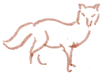 and
me, mine and yours, past and future, dead and alive, male and female, long
and short, and so on — in a word, informed by the word “and”;
for more about that, please
see
our book In The Beginning). What is One and Only One is perceived as if it were
many. The One does not become many; it is simply perceived that way. In
our view, that is neither good nor bad; it simply is. But if a seeker wishes
to see the One, which is his or her very Self, as it is in Truth, then the
ego, like the prism, must go.
and
me, mine and yours, past and future, dead and alive, male and female, long
and short, and so on — in a word, informed by the word “and”;
for more about that, please
see
our book In The Beginning). What is One and Only One is perceived as if it were
many. The One does not become many; it is simply perceived that way. In
our view, that is neither good nor bad; it simply is. But if a seeker wishes
to see the One, which is his or her very Self, as it is in Truth, then the
ego, like the prism, must go.
We suspect that the argument to which you refer is not new, just resurfaced. That is, variously stated, it has almost certainly been around since the beginning of time. It is in the nature of the ego to attempt to distract a seeker from the Goal, and in that effort, to use whatever means are necessary, including, in one form or another, the promise, “I know I’ve been bad before, but I’ll be good now”. It is a seeker’s responsibility, and ultimately his or her supreme joy, to see through it.
To The Zoo Fence: You once suggested a practice for tuning the body’s chakras that I used with benefit. Now, a friend has asked me about it, and I cannot recall the details. Can you? If so, would you repeat it for me, please.
Naples, Florida
Editor’s Comment: The practice you refer to, called “Sounds of The Centers”, comes from the book “Energy Ecstasy and Your Seven Vital Chakras” by Bernard Gunther. We believe this exercise was originally developed by Jack Schwarz. Based upon our tremendous respect for Jack, and our own personal experience, we heartily recommend it. (The chakras are seven subtle energy centers that correspond, more or less, to points along the physical spine, the proper energizing and harmonizing of which is believed to have healthful and other beneficial consequences at every level of being. You may notice that, in this exercise, the colors associated with the chakras differ somewhat from colors associated with them in other sources.)
Take a deep breath
through the mouth
and make the sound
LA
as you make this sound
let it vibrate
at the base of the spine.
on the next breath
as you make the sound
LA
see a red orange light
radiating/vibrating
at the base center.
on the third breath
make the sound
LA
and see a white light
as you vibrate the sound
in the base center
 Repeat this sequence, changing
the sound, color, and location for each chakra, thusly:
Repeat this sequence, changing
the sound, color, and location for each chakra, thusly:
spleen: sound BA, color pink
solar plexus: sound RA, color kelly green
heart: sound YM (Ya Mm), color yellow-gold
throat: sound HA, color sky blue
brow: sound AH, color indigo
crown: sound OM, color purple
Always end each procedure with white light in the chakra you are working
on.
For additional letters, please choose from the menu at left,
or click here.
It is inconceivable that God should exist, and inconceivable that He should not exist.
Blaise Pascal Q
The saints, when they remember their sins, do not remember the sins but the mercy of God, and therefore even past evil is turned by them into a present cause of joy, and serves to glorify God.
Thomas Merton Q
A month ago, I met myself, as I was speeding away from some trifle to chase a new one, and knew that I had eaten lotus and been a stranger from my home all this time. And now I see that, with the word and thought in my mind, another wave took me and washed my remembrance away, and only now I regain myself a little and turn in my sleep.
Ralph Waldo Emerson Q
A man [or a woman] who does not believe in himself [or herself] is an atheist.
Swami Vivekananda Q
Please read our disclaimer.
For Copyright information,
please click here